NASA is Paying SpaceX to destroy the $160 Billion Space Station
This small company is poised to build the new one...
Sixteen nations spent thirteen years building the International Space Station.
At a cost of $150 billion, it is the most expensive object human beings have ever made.
And NASA is paying Elon Musk up to $843 million to destroy it.

SpaceDaily calls it "the most expensive demolition job ever commissioned."
SpaceX will drag all $150 billion of it down through the atmosphere and sink it in the South Pacific Ocean.
But here is the part almost nobody has worked out yet.
NASA is not paying Elon to build the replacement.
He gets paid to carry it up into space. That is all.
The company already building a replacement is a tiny space firm — less than half a percent the size of SpaceX.
And I believe it is about to become one of the most important companies in America…
Which could hand early investors potentially up to 39X their money.
In the next few minutes, I'd like to tell you all about it…
But first, let me introduce myself.
My name is Dylan Jovine.
I spent my career on Wall Street.
I got my first job with Peter Jaquith, one of the investment bankers who became famous for saving New York City from bankruptcy.
My clients bankrolled me to start my own brokerage firm when I was twenty-four years old.
I have been doing this for over three decades.
And in all that time I have rarely seen a setup this lopsided:
A contract worth billions…
A winner hiding in plain sight…
And a hard date on the calendar when the whole thing becomes public knowledge.
Let me walk you through it the same way I walked through it myself.
Why I Told My Readers
to Stay Away From the SpaceX IPO
When SpaceX went public, I spent weeks telling my readers to be cautious.
I said most of that value was captured by private investors years ago.
I told them not to chase the opening pop.
I meant it. And I still mean it.
SpaceX is one of the finest companies ever built.
There are serious people — Baron Capital among them, a firm that has been around for decades and manages tens of billions of dollars — who believe SpaceX could be worth $10 trillion one day.
I think that is a very real possibility.
But do the math with me.
SpaceX is already valued at almost $2 trillion.
From here to $10 trillion is roughly a 5X gain. Enough to turn $10,000 into about $50,000 — and it could take years to get there.
That is a nice return.
It is not a life-changing one.
Because the real winners were the insiders.
Peter Thiel invested in SpaceX when the firm was valued at a measly $420 million.
Today SpaceX is worth almost $2 trillion.
That is more than 4,000 times what it was worth when Thiel wrote that check.
The big winners with SpaceX were NOT retail investors…
The big winners were the people close to Elon.
Folks he had known for years.
SpaceX stayed private for twenty-four years — you could not have bought a single share if you had begged for it.
By the time you and I were finally permitted to own a piece, the big money had already been made and handed out.
The public always gets the exit.
But There Was a Second Group of People
Who Got Rich Off SpaceX
Folks with no insider connections.
No accreditation.
No special access.
They simply bought the smaller firms attached to SpaceX.
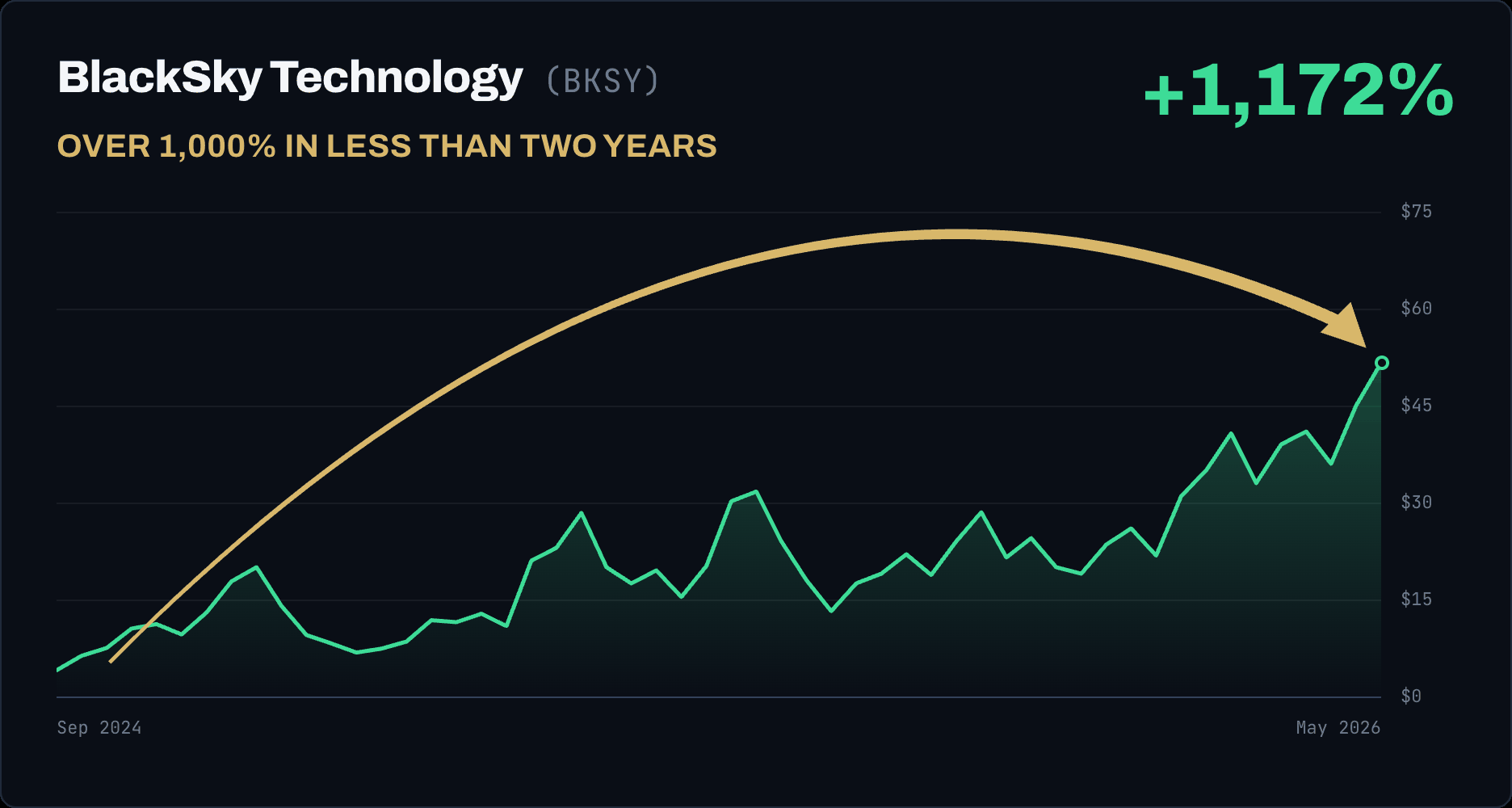
Like BlackSky, a tiny company that launched satellites on SpaceX's Falcon 9 rideshare missions. Shares have soared as high as 1,172%.
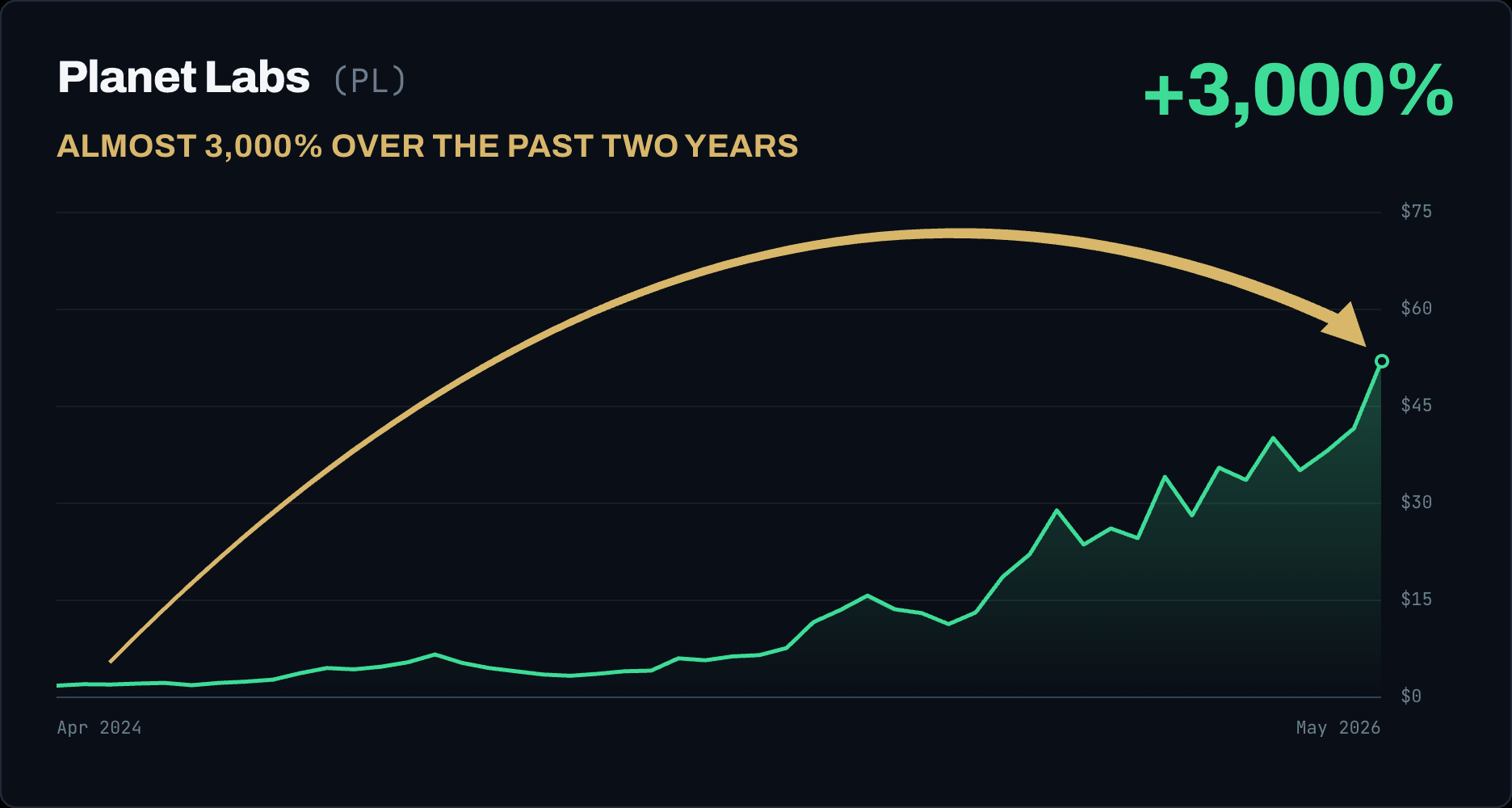
Or Planet Labs, a firm that sells satellite data to governments and corporations all over the world. Shares have exploded as much as 3,000% over the past two years.
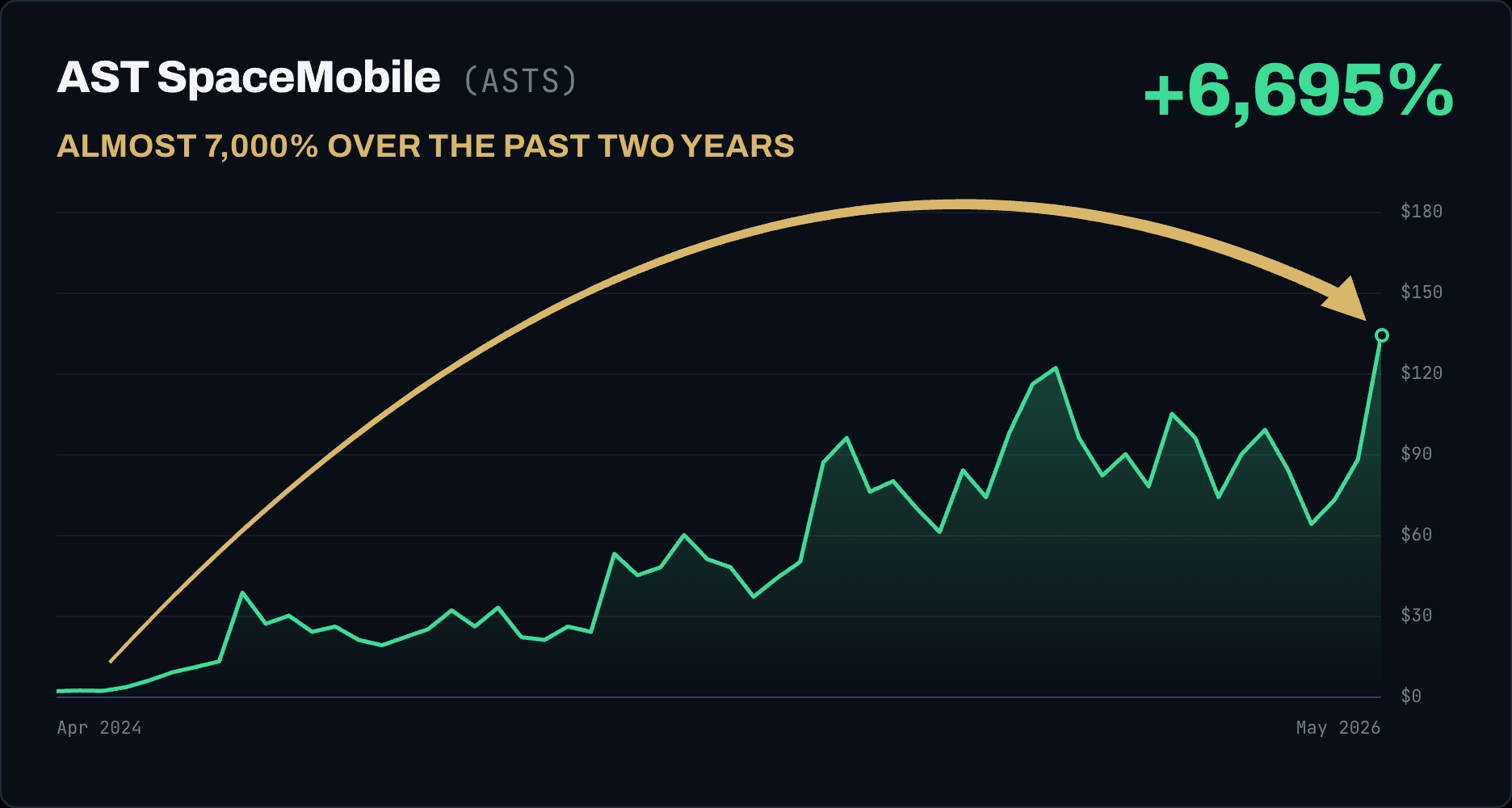
Or AST SpaceMobile, a firm that builds cell towers in space.
Over the past two years shares have jumped as high as 6,695%.
Those are the kinds of gains that can actually change a life.
If you buy SpaceX today and it eventually hits $10 trillion, you 5X your money.
That buys a new car. A nice vacation.
But a 70X return, like investors had a chance to see on AST SpaceMobile?
That is enough to stop worrying about money for a very long time.
And to be clear…
These are NOT stocks I recommended to my readers.
Simply examples the market has shown over time.
But my readers had a chance to ride this Space-boom all the way from the beginning as well.
Just take a look at this…
This Is Not the First Time I Have Made This Call
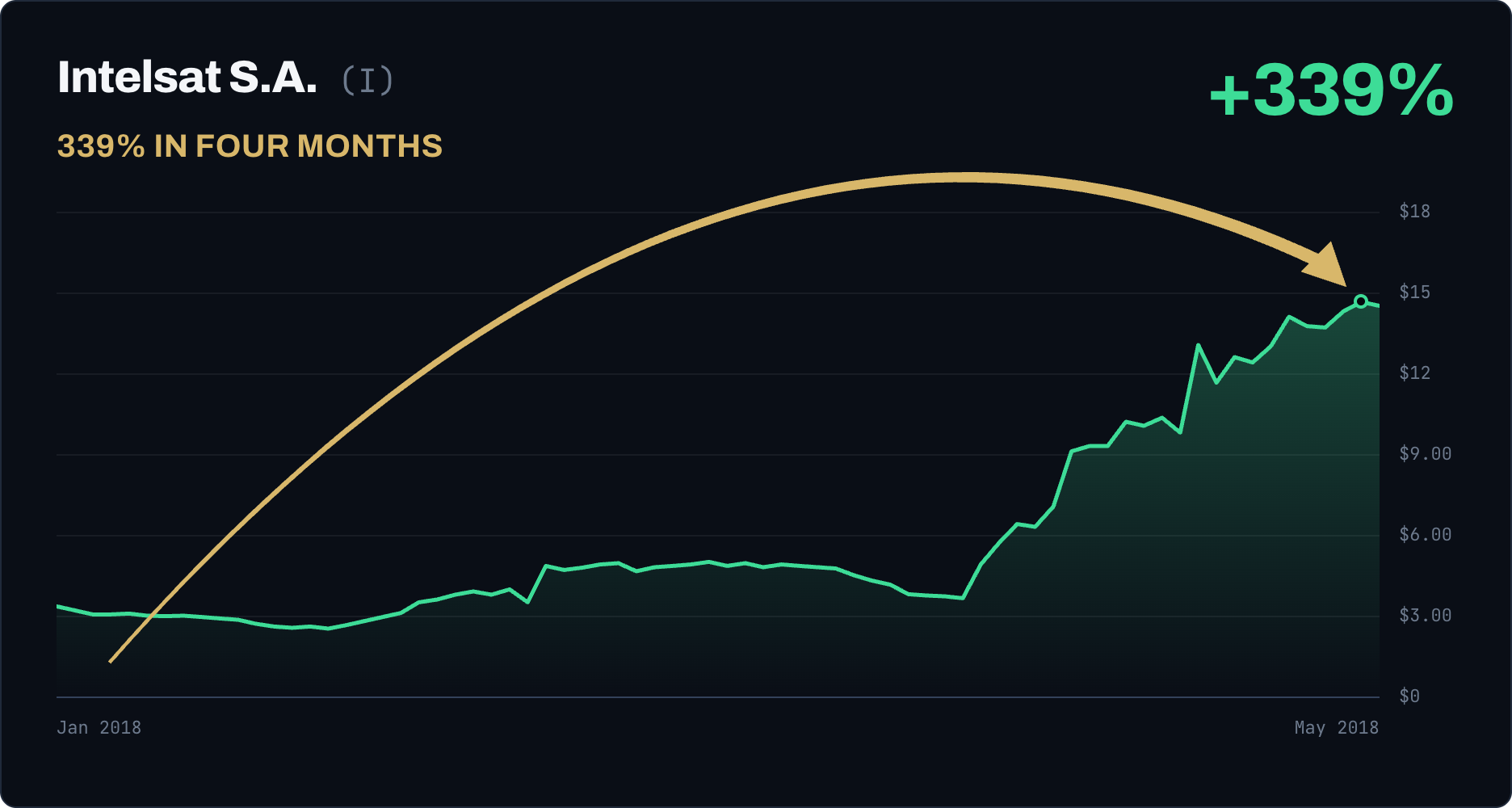
Back in 2018 — years before space stocks were a story — I recommended a satellite company called Intelsat at $3.30 a share.
My readers had the chance to lock in a 339% gain in just four months.
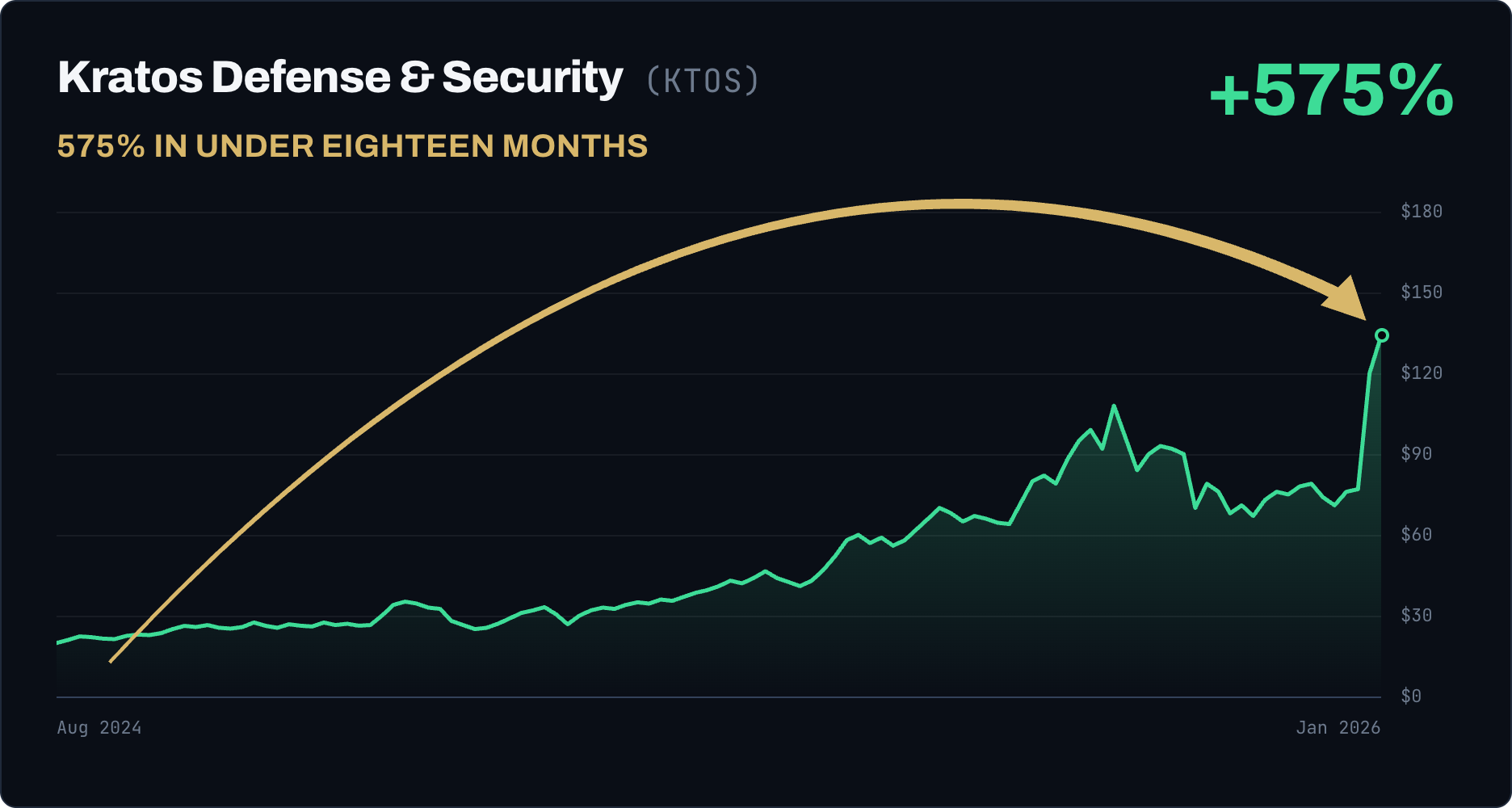
Then I found Kratos, the maker of America's Valkyrie space drones.
Readers who followed me had a chance at a 575% gain in about a year, as shares ran from under $20 to $134.
And then there is Rocket Lab.
I recommended it back in 2024, when shares were trading for under $4.
Since then the share price has surged as high as $151 — a return as high as 3,874% in about two years.
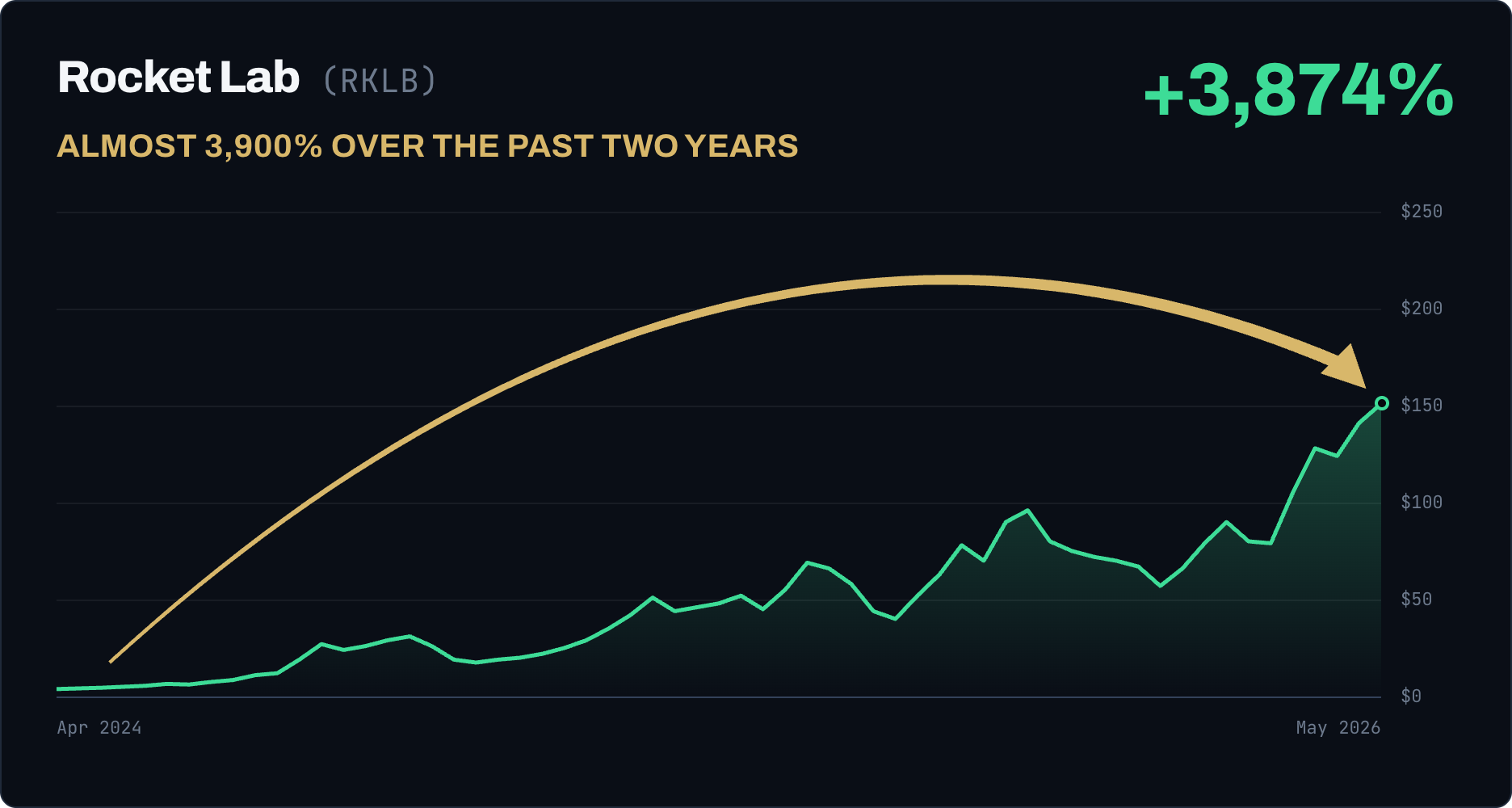
That last one alone is enough to turn a $5,000 stake into almost $200,000.
For the average American, that is enough to pay off a mortgage.
And that's why I'm pounding the table on this tiny, SpaceX-partnered firm today.
Because I've learned a major lesson over the past three decades I've been doing this:
When every news outlet in America tells you about a huge opportunity, the big money is already gone.
You do not want to buy stocks when every financial outlet is hyping them.
You want to look out at the frontier and find the tiny, undervalued companies before they become household names.
That is the only place you will ever see returns that change your financial trajectory.
That brings us back to…
Now — the Strangest Contract of Elon's Career
Look at what NASA has already handed over to Elon Musk.
First they paid him to haul their cargo, because the agency decided it no longer wanted to fly its own supply runs.
Then they paid him to carry their astronauts, and wrote him a check for $2.6 billion to do it.
And now this.

NASA is paying SpaceX up to $843 million to destroy the International Space Station.
And how do you destroy something that big?
SpaceX is building a special vehicle for the job.
One of a kind.
TechCrunch calls it "a Dragon on steroids" — a monster version of their crew capsule, loaded with six times the normal fuel and 46 thrusters.

Its job is to latch onto the station and drag all 430 tons of it down through the atmosphere.
And here is the strangest part.
This spacecraft will fly exactly once.
It does not come back.
It burns up and sinks into the Pacific, together with the station it just destroyed.
Elon is building a $680 million spacecraft designed to be destroyed.
The contract itself is just as unusual.
See, when SpaceX hauls cargo or astronauts, NASA buys it as a service and Elon owns the rockets.
Not this time.
This time NASA will own the vehicle, and NASA will operate it.
That has never happened between NASA and SpaceX before. Not once.
And how does Elon feel about being NASA's demolition man?
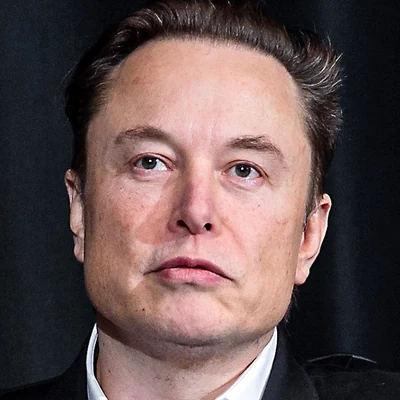
He cannot wait. Earlier this year he went on X and told the world:
 CEO, SpaceX
Once the Old Station Is Gone, a New Era Begins
It is no longer NASA running the show up there.
Private companies start building their own stations. Private labs open up in orbit.
JP Morgan calls it the next phase of the space economy — an entire new multi-trillion dollar industry.
And SpaceX carries everything and everyone up there.
That is a huge reason SpaceX could grow into a $10 trillion company over time.
But again — SpaceX is not the big winner here.
They get paid to demolish the ISS.
But they don't get paid to build the replacement.
The firm already building a replacement is a tiny company 99% of investors have never heard of.
And here's why I consider this such an incredible opportunity…
A "Silent Partner" Could Own the New Space Station…
And Collect Up to $1 Billion a Year From NASA
Start with the size of it.
This company is valued at a measly $2.5 billion.
Less than 0.5% the size of SpaceX.
Then look at the structure of the deal, because this is the part that made me sit up.
NASA will not own the successor to the ISS.
NASA will not operate the successor to the ISS.
They will have a private company build it and run it.
And NASA has already told Congress it plans to spend roughly $1 billion a year on that service.
This tiny firm is already building it.
Whoever builds it becomes the landlord of the new space station. NASA becomes the tenant.
And NASA has budgeted roughly $1 billion a year in rent.
Put that next to a $2.5 billion company.
If this firm wins, NASA could pay it more in rent within three years than the entire company is worth today.
And that is only the beginning.
Because this company is not just collecting money from NASA.
They have already signed over half a billion dollars in contracts with other firms that want to use the ISS successor.
NASA itself says the ISS has been a "key part of supporting" the growth of the commercial space economy.
And now a private company will run the replacement… and be at the center of this massive opportunity.
To give you an idea how lucrative this investment could be…
Like Investing in the Early Internet
McKinsey says we are at the "early internet" stage of a private space economy that could grow to trillions of dollars.
And on top of all of that, this company runs one of the fastest-growing defense businesses in the United States.
The profit potential here is staggering.
Remember, my readers had a chance to book a 39X gain on Rocket Lab…
And I believe this tiny firm could do just as well, if not better.
Are you starting to see why I believe this could be another multi-bagger like Rocket Lab?
And in case you're wondering…
But Why Destroy the ISS In the First Place?
It is a fair question, and the answer is simple.
Think of the ISS as America's permanent laboratory in space.
We use it for microgravity research, to study how the human body holds up in space, to test new technologies before they fly anywhere else.
So why demolish it?
Because it is old.
The station was designed to last fifteen years.
It has been up there for twenty-five. And it is starting to fall apart.
The hull has been cracked and leaking air since 2019, and nobody can fix it because nobody can find the source.
NASA now calls those cracks the number one safety risk on the entire station.
And if you demolish a laboratory that important, you have to replace it.
It Is Not Even a Choice.
It Is Politics.
Because America has a rival in space.
Back in 2011, Congress banned China from the ISS.
They did not want Beijing anywhere near our cutting-edge space technology. It was an obvious security risk.
So China built their own station. It is called Tiangong, and it is circling over our heads right now.

China openly says Tiangong is "the biggest and most important space project China is carrying out."
If America does not build a replacement, then the day the ISS comes down, China becomes the only nation on Earth with a station in orbit. Our main rival would own the high ground.
No President wants that on his watch. Republican or Democrat. It cannot be allowed to happen.
That is why NASA is rushing to build a successor. And again: NASA will not operate it.
They will pay SpaceX to demolish the old one, and pay a private firm to design, build and operate the successor.
And this tiny firm has already started building.
So while everybody's eyes are on SpaceX…
I believe this tiny "Silent Partner" could be much more lucrative.
It's a pattern that we've seen over and over in the past.
The BIG Money Has Never Been in the Famous Company
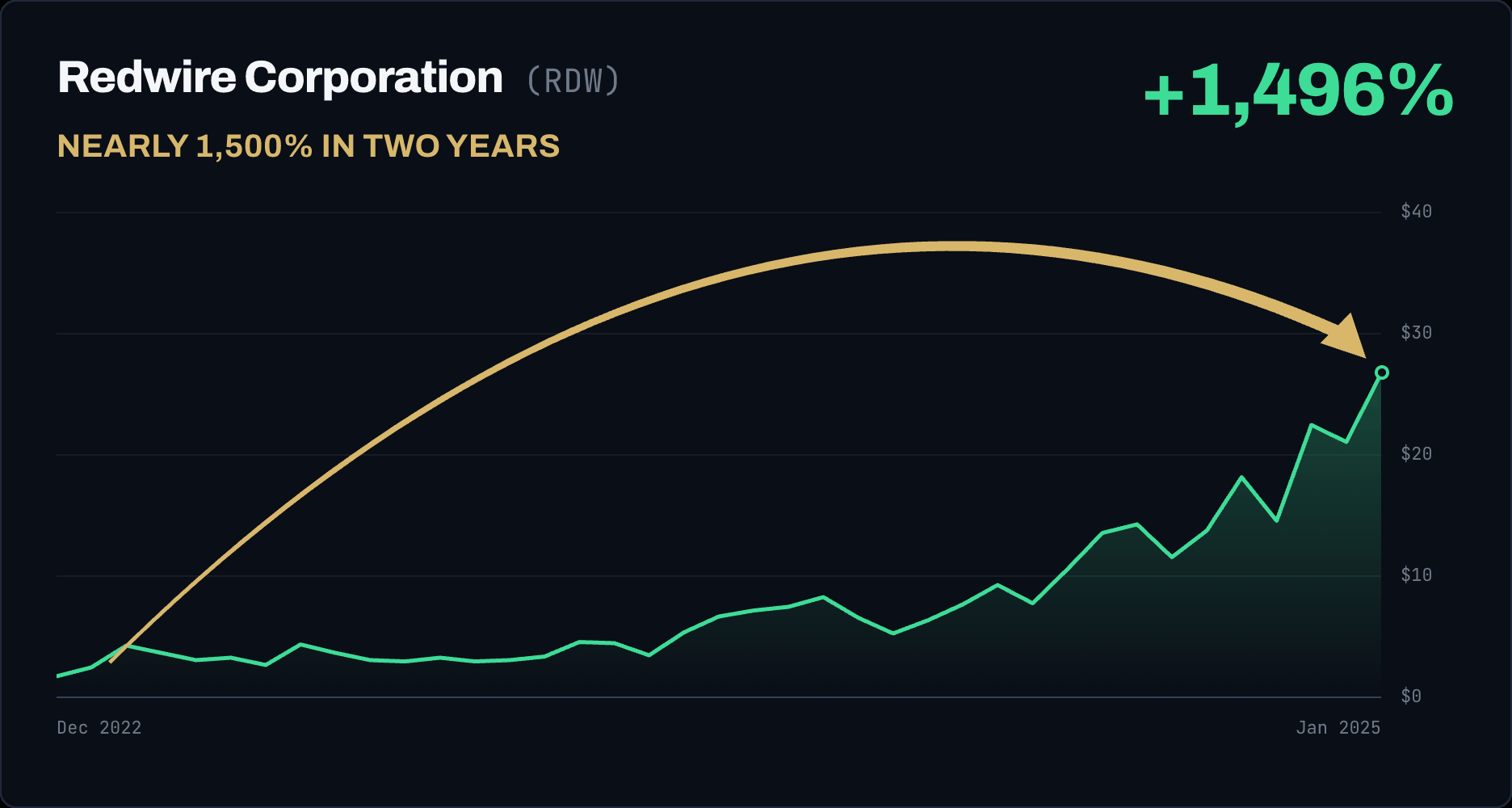
Take Redwire for example.
A tiny supplier that builds the hardware that goes inside space stations — solar arrays, robotics parts, plant growth systems for the ISS. And SpaceX?
SpaceX got paid to carry Redwire's hardware into orbit.
Shares in the tiny supplier have soared as high as 1,496%.
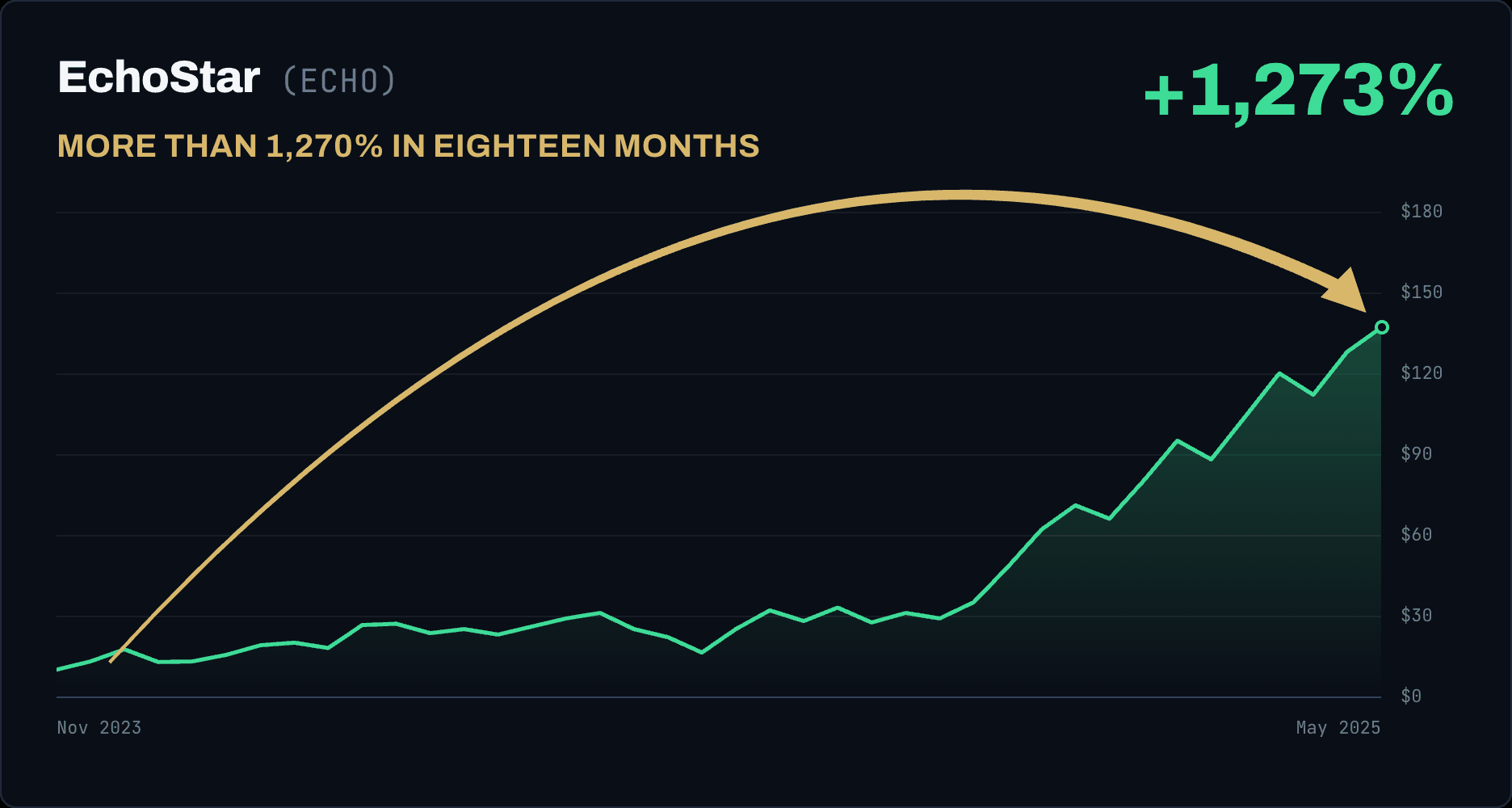
Or EchoStar.
A satellite firm that owned wireless spectrum — think of it as the radio frequency that lets satellites talk to each other.
SpaceX needed that spectrum badly for Starlink, so they flat out bought it in a $20 billion deal.
Investors had a chance at 1,273%.
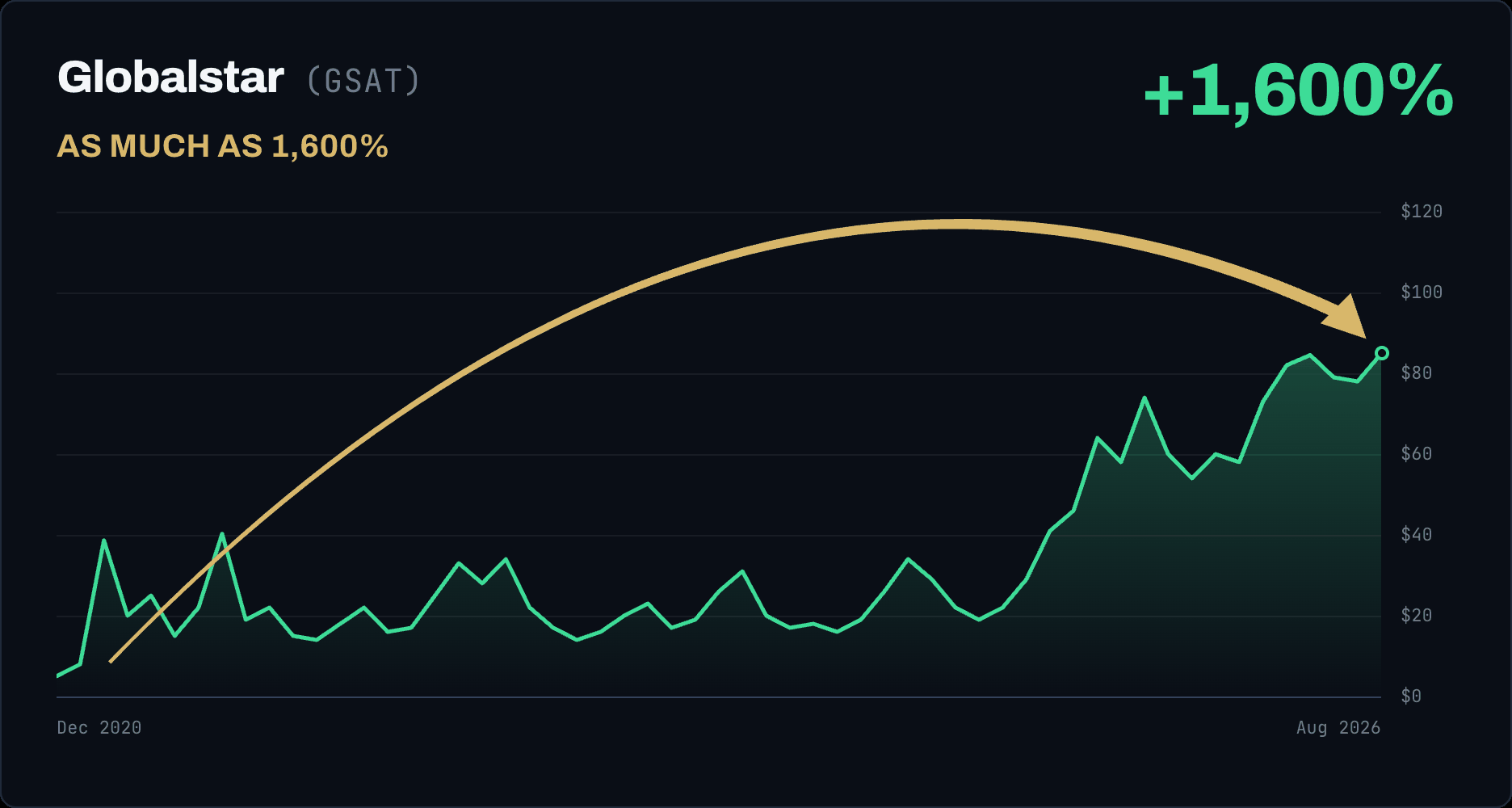
Or Globalstar.
Another obscure firm running its own satellite constellation.
They have no rockets of their own, so they pay SpaceX to ride their satellites into orbit — and a while back Apple cut a deal with them to power the iPhone satellite feature.
Shares have run as much as 1,600%.
Then Amazon cut an $11.57 billion deal to buy out the entire firm and power their Starlink competitor.

Isn't that incredible?
That's what most investors don't realize yet.
When they hear "space" they think it's science fiction.
But we are talking about Apple and Amazon here.
These are some of the biggest, most important tech firms on the planet…
And they're pouring big money into the space economy as we speak.
I guarantee you, 99% of Americans are still sleeping on this opportunity.
Wall Street is waking up, though.
Goldman Sachs calls space a multi-trillion dollar opportunity.
And they are saying something even more striking about where this goes.
Just like the early internet.
And you know what the right investment did for people back then.
Early investors in Internet stocks had a chance to see serious windfalls.
And I believe we're about to see a similar boom again.
Just to give you an idea how lucrative this "Silent Partner" could be…
Let me show you what that looks like in dollars.
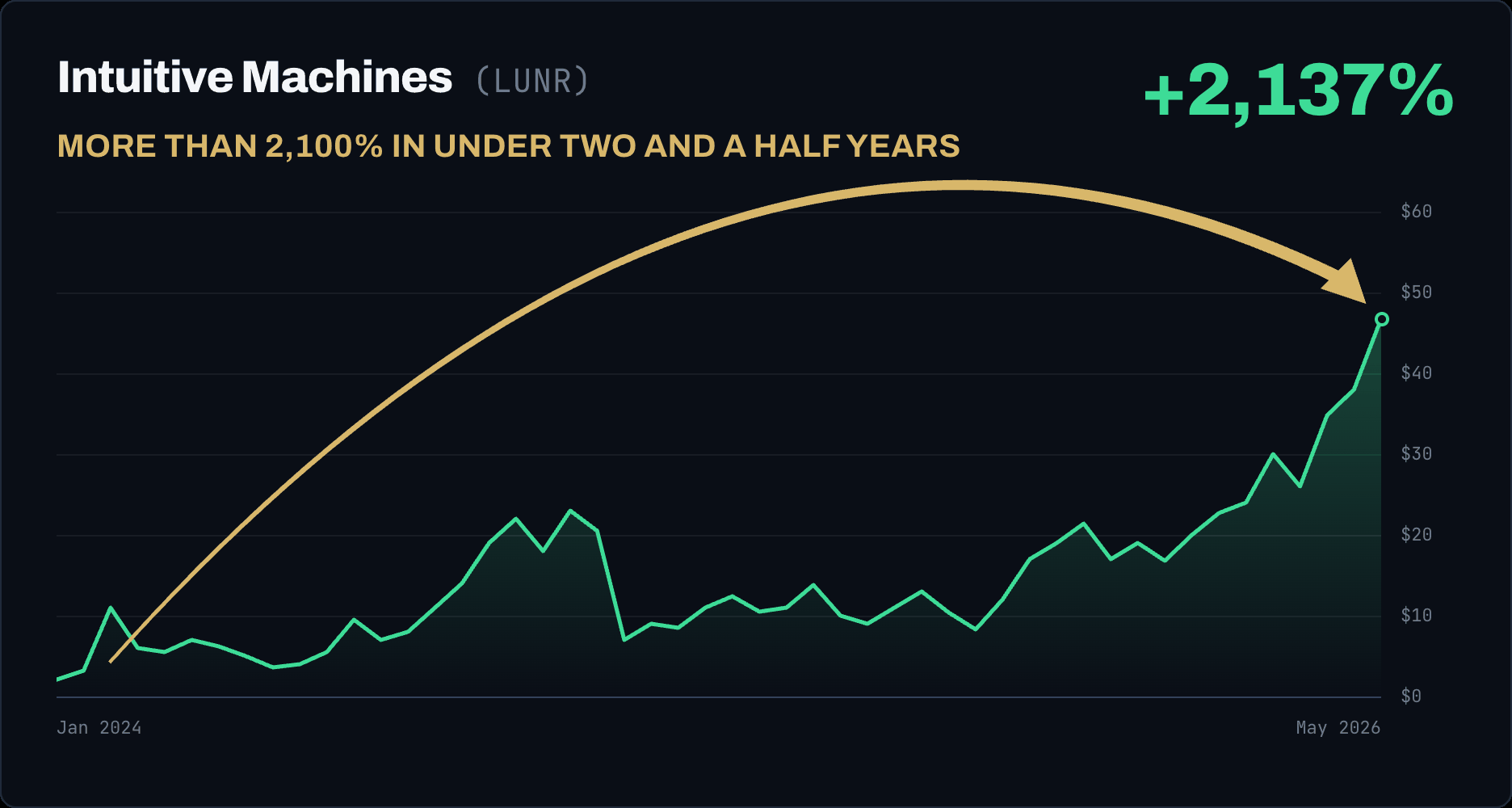
Intuitive Machines, the moon landing company, has soared as high as 2,137%.
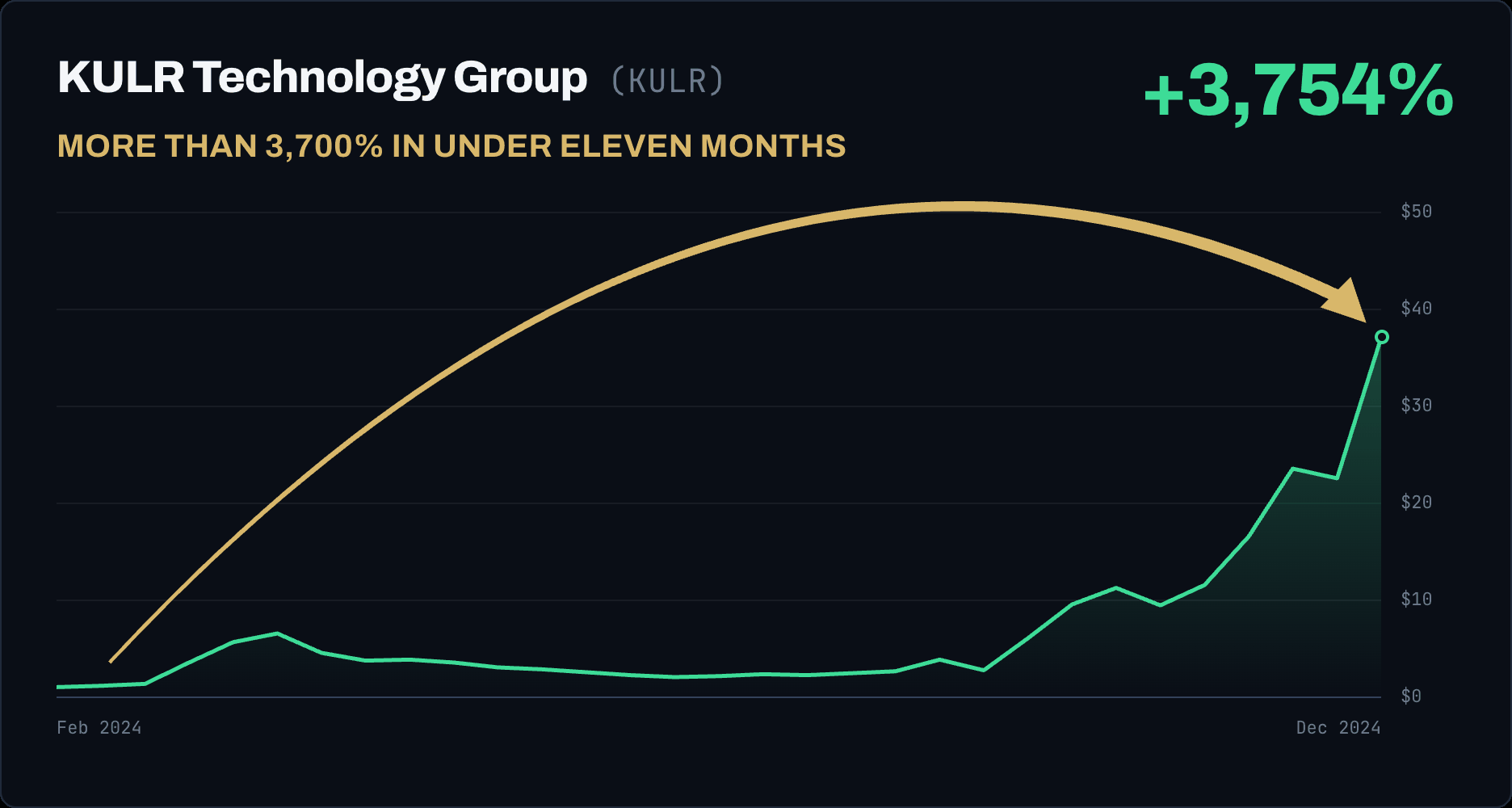
KULR Technology Group, up as much as 3,754% in under eleven months.
And AST SpaceMobile, up almost 6,700%.
You could have simply put $5,000 into each of those three.
No insider connections.
No special brokerage.
Nothing but a regular account and the willingness to buy the tiny suppliers attached to SpaceX.
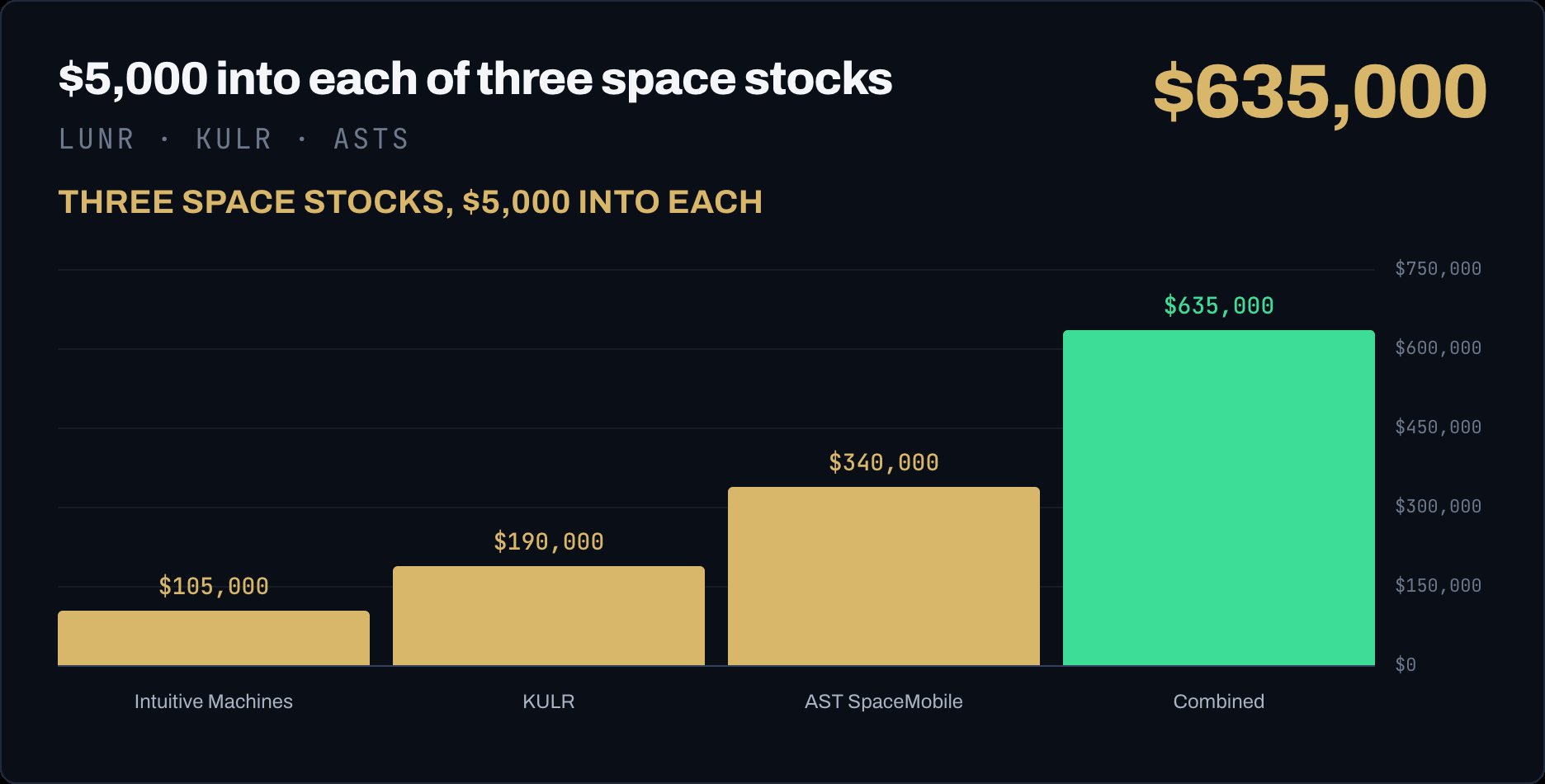
You would be sitting on $635,000.
Past performance does not guarantee future results. These are peak returns, not realized ones, and every one of these stocks fell hard at some point along the way.
That is the power of frontier investing.
And it is exactly why I am pounding the table on this tiny space company at the center of the historic SpaceX deal.
Five Reasons I Believe This One Firm Wins
the Biggest Space Station Contract since the ISS
I am not going to ask you to take my word for it.
Let me lay out the evidence the way I laid it out for myself, one reason at a time, and you can decide whether you see it the same way.
Reason One
Their Hardware Is Already Bolted to the Space Station
This company has already built crucial parts of the existing ISS.
Their equipment is attached to the station right now, as you read this.
In fact they built the only privately-owned piece of the entire International Space Station.
NASA works with thousands of suppliers.
Only one of them owns a working part of the existing ISS.
This one.
They have proven they can build this — in orbit.
Nobody else in this race can say that.
Not SpaceX.
Not Blue Origin.
Nobody.
Reason Two
NASA Has Been Funding Them Since 2021 — Specifically for This
NASA has already funnelled $200 million into this tiny space company to design the ISS successor.
Not for research in general.
For this exact job.
Think about what that means.
This is not some fly-by-night outfit that turned up when the contract was announced. NASA has been paying them to prepare for years.
Reason Three
NASA Has Already Signed Off on the Design
Just a few weeks ago, this firm's design passed NASA's official review.
The design is finished. Reviewed. Cleared by NASA.
They have even built a life-size mockup of the ISS successor at the Lyndon B. Johnson Space Center in Houston. A full-scale model of it sits at the Johnson Space Center right now.
Reason Four
The Rocket Ride Is Already Booked and Paid For
This tiny company has signed a contract with SpaceX and paid Elon $90 million to carry their station into orbit.
The design is finished.
The model is built.
The ride is booked.
Reason Five
The Giants Who Built the Original ISS Joined Them
Replacing a $150 billion station is an enormous job, and this company is not attempting it alone.
They have partnered with the very same aerospace giants that built the original ISS — the firms that designed its labs, its cargo ships, its robotic arms.
One of them is Northrop Grumman, one of the biggest defense firms on the planet.
In fact, Northrop wanted to build their own version of the ISS replacement.
Then they saw how far ahead this tiny company already was.
So they scrapped their plans and joined them instead.
This is NASA's own language:
If you can't beat them, join them.
Why NASA Picked This Tiny Firm Over SpaceX
to Design the ISS Replacement
You might be wondering why NASA does not simply pay SpaceX to build the replacement too.
The answer tells you everything about why I love this tiny firm.
SpaceX is a transportation company.
They build rockets, they haul cargo, and they carry astronauts.
Nobody on Earth does it better.
But building and running a space station is a completely different job.
And that is exactly what this firm has mastered.
The core team behind it has been working on the ISS for over 15 years.
They built crucial commercial infrastructure for the station, including an airlock that became the first privately owned module ever attached to the ISS.
NASA has been paying this firm for about six years already to operate a crucial part of the ISS.
This team has deployed over 300 satellites. They have overseen more than 1,000 customer missions for organizations from over 35 countries.
And NASA has funneled more money into this firm than into any other competing contractor.
That is why NASA has been paying this tiny firm to design the ISS successor, and not SpaceX.
Elon is the best in the world at getting things into space.
These guys are the best in the world at running a business in space.
Everyone sticks to what they do best.
SpaceX delivers the station.
This tiny firm builds it and runs it.
So Why Isn't Every Investor Piling In?
That is the question.
And the answer is the reason I am writing to you today.
See, NASA cannot simply hand out a contract this size to whoever they want.
Federal law says a contract like this has to go through open competition.
NASA has to publish the offer, let multiple companies bid, and run a formal process.
So on paper, officially, no winner exists yet.
But you have seen the facts for yourself. Out of every firm competing for this contract:
- This is the only one already operating major infrastructure on the existing ISS.
- It is the only one whose design has already cleared NASA's official review.
- It is the only one that teamed up with the industry giants who built the original.
- And one of the largest defense firms on Earth abandoned its own space station to join them.
No other firm comes close.
But for the big Wall Street funds, that is not enough.
They want 100% certainty.
They will pile in after NASA makes it official.
Which is exactly why this is time-sensitive.
The "NASA Effect" Has Sent Tiny Space Stocks
Soaring as High as 225% In a Single Day
Because once NASA announces a contract like this, shares can move violently. It has happened again and again.
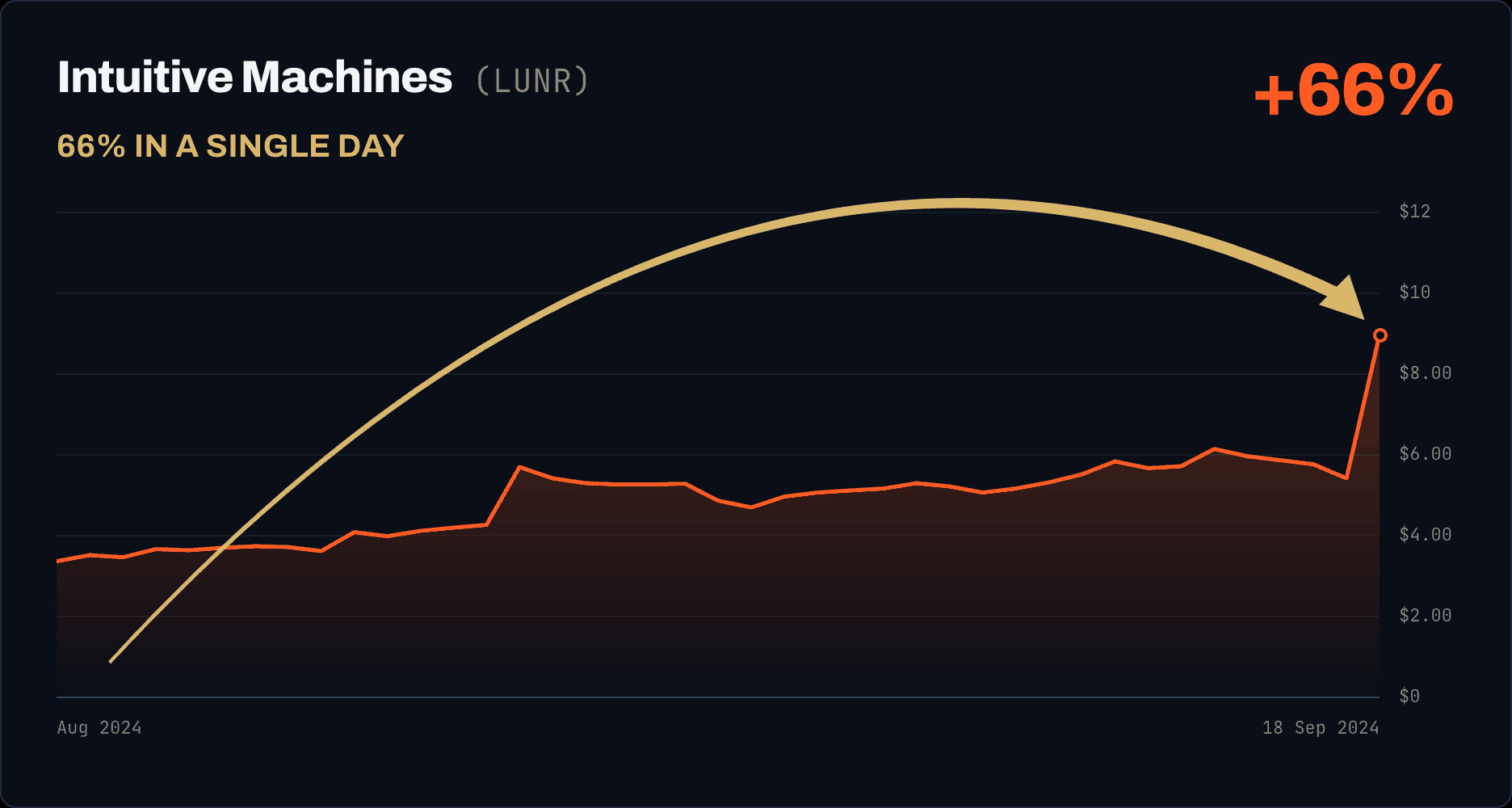
NASA hired Intuitive Machines to build a communications network around the Moon — the satellites that let NASA talk to its spacecraft up there.
The day the news hit, the stock exploded as much as 66% in a single day.
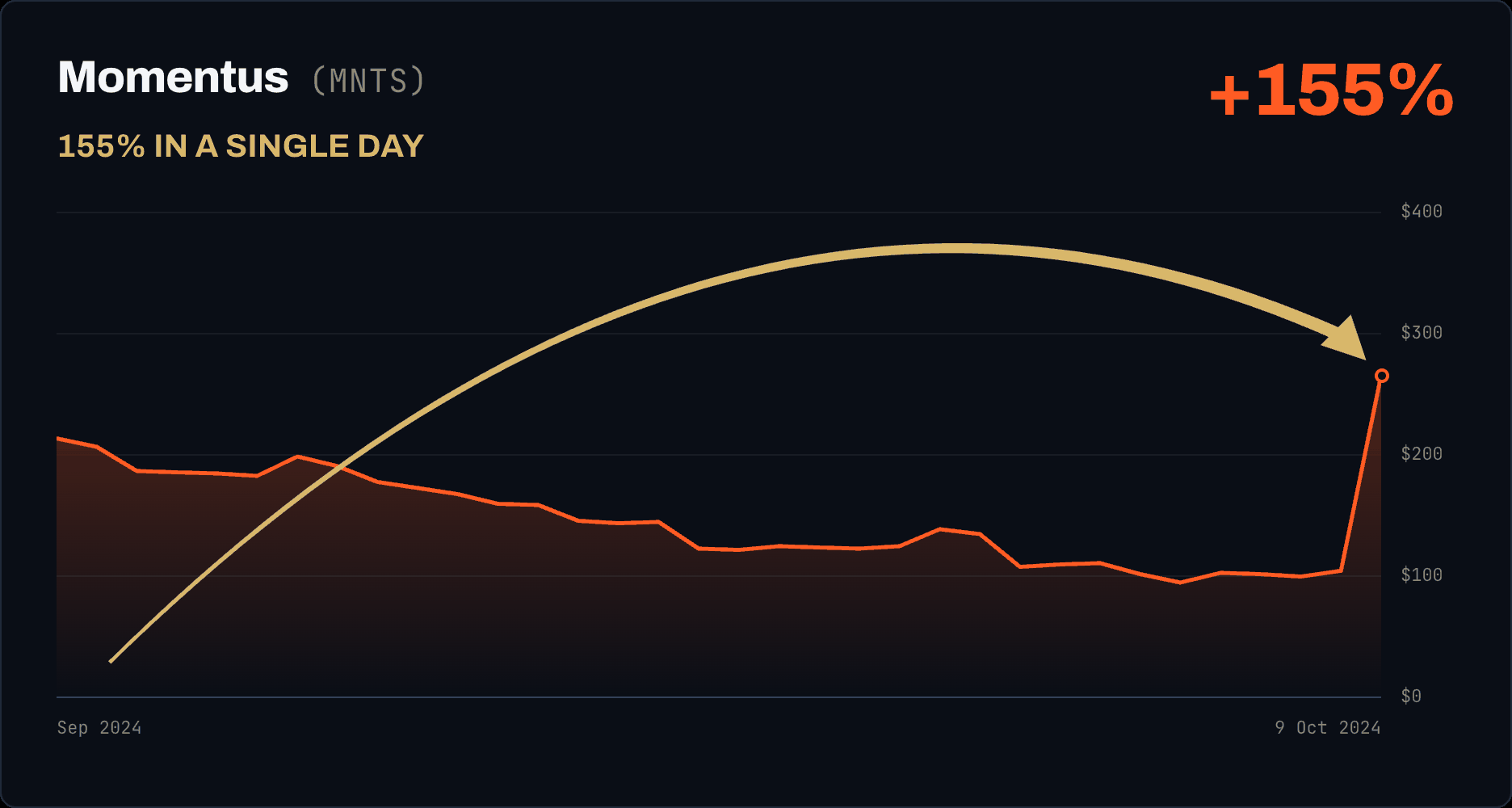
Then there is Momentus, which NASA selected to launch equipment into orbit on future missions.
NASA did not cut them a check.
NASA did not award them a mission.
All NASA did was put Momentus on a list of approved providers.
Shares soared 155% in a single day.
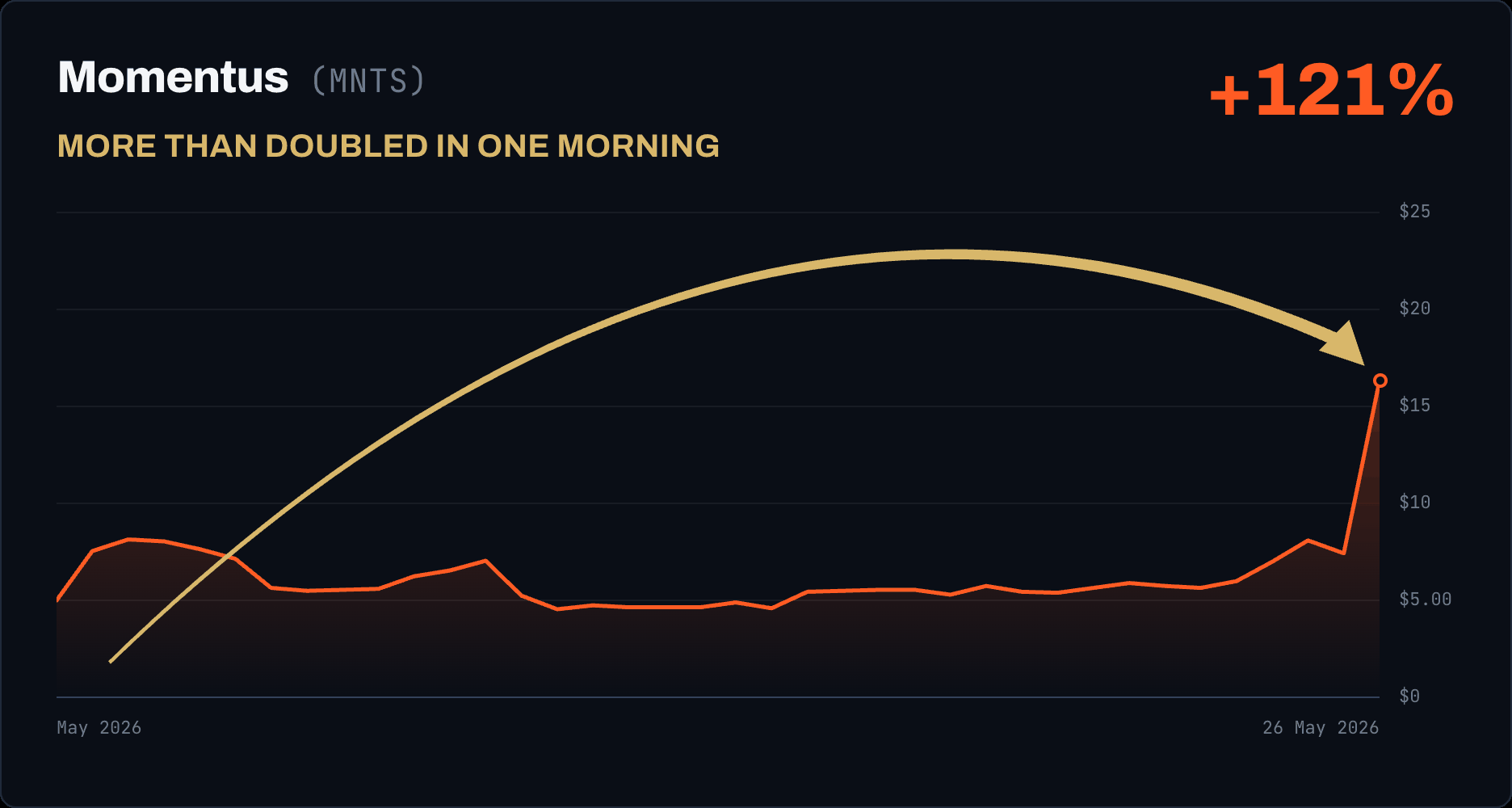
And later, when Momentus announced a NASA study about robotics, shares more than doubled again in one morning.
It gets crazier.
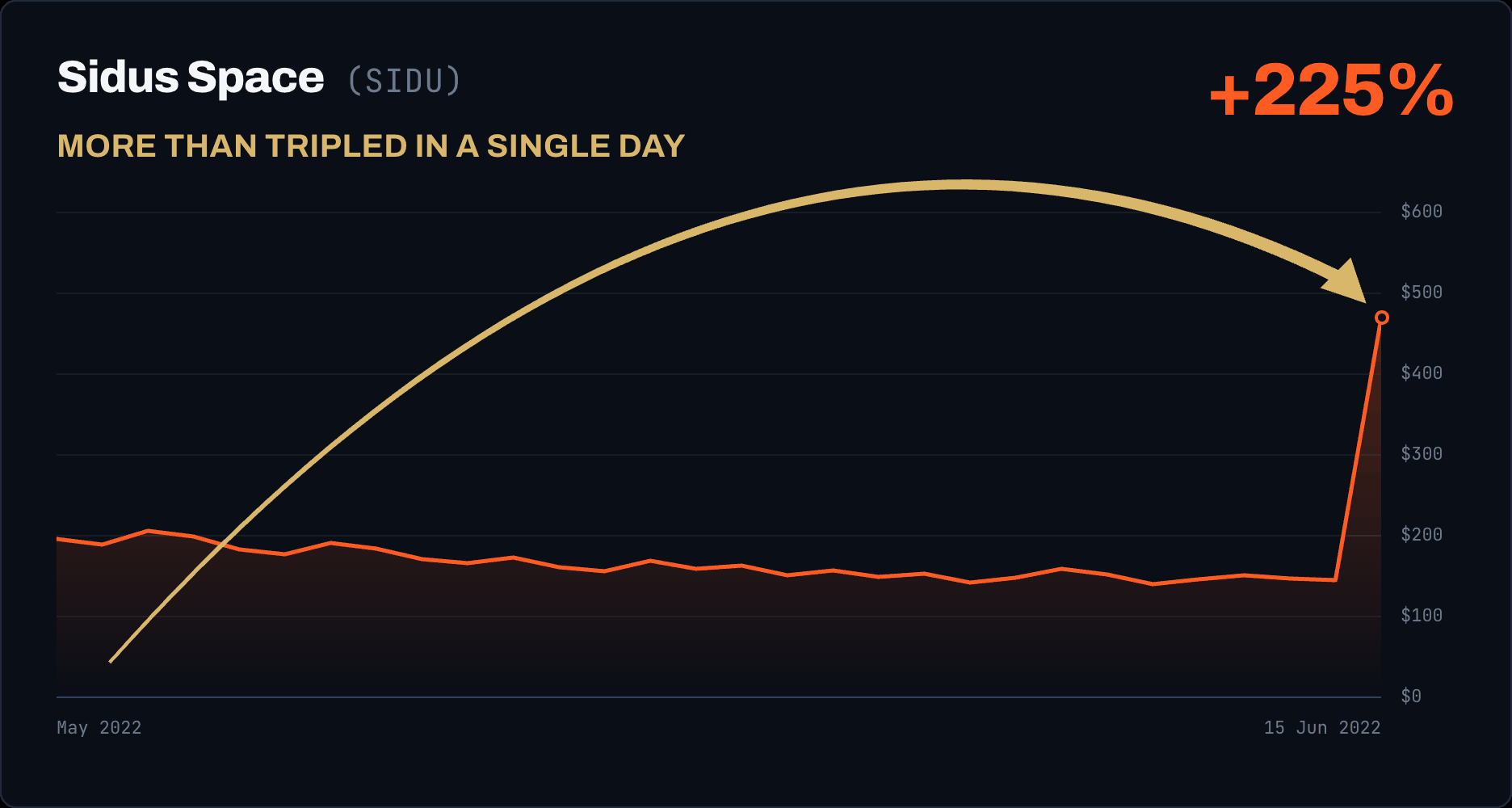
A few years ago NASA awarded a $3.5 billion contract to build the next generation of spacesuits — the suits astronauts will wear on the Moon.
The big winner on that team was Collins Aerospace, a household defense name.
But there was a tiny subcontractor on that team called Sidus Space.
The day the news hit, Sidus shares exploded 225% in a day. More than tripled — and they were not even the main contractor.
Notice the pattern. Every time NASA's name lands next to a tiny stock, it goes vertical.
Oftentimes, the same day.
That's why this is such an urgent opportunity…
There Is a Hard Deadline on the Calendar
Even though this firm is clearly ahead, NASA has to open the contract to multiple bidders because of federal regulations. They have already published the draft call for bids.
The final one is expected any day now.
And is when NASA's new fiscal year starts.
That is when the money gets deployed.
And that is when NASA will pick the winner.
That is when this story moves from obscure space blogs to the major financial outlets, and every analyst in America starts looking into this tiny firm.
How High Could Shares Realistically Go?
I do not like to guess.
But we can look at real-world data, because we have plenty of examples of what these tiny space stocks are capable of.
Take Maxar Technologies, an obscure firm specialising in satellite images.
A few years back you could buy Maxar for under $4 a share.
Then the space economy started heating up, and a private equity firm bought out the entire company at $53 a share. In cash.
That is a gain of nearly 1,300% — enough to turn $10,000 into roughly $140,000.
And Maxar is the small winner.
Planet Labs, which operates one of the largest satellite fleets in orbit, has exploded as much as 3,000%.
That turns ten thousand dollars into over $300,000.
These are not risky options plays.
Not crypto.
Not private deals you need insider connections to reach.
These are regular stocks, bought in a regular brokerage account.
And my Rocket Lab readers had the chance at a 39X return simply by buying and holding.
That is the kind of number you do not see in normal stocks.
Even better…
You do not need a fortune to take advantage of this.
With a giant like SpaceX, you need to invest a lot of money to move the needle.
Say you put $20,000 into SpaceX and it hits a $10 trillion valuation, which could take years to play out.
You roughly 5X your money and end up with $100,000.
Now compare that with a SpaceX supplier like AST SpaceMobile, up almost 6,700%.
The same $20,000 would have turned into over $1.3 million.
One buys you a nice car with some money left over for a vacation.
The other buys you a nice home pretty much anywhere in America.
To be clear, I am not promising a 6,700% gain on this space firm.
Nobody can promise anything like that.
But that is the kind of potential you are looking at.
With these tiny firms, even a small stake can grow into something substantial.
And you do not need any special account.
This stock trades right where your other stocks do, in the brokerage account you already have.
These are not normal stocks. That is the entire point.
So How Do You Get In?
I have put everything you need to know into a brand-new research report. Inside you get the name, the ticker symbol, and my full analysis — everything you need to take a position right away.
Your first report
SpaceX's Superdeal: The Tiny Firm Poised to Soar
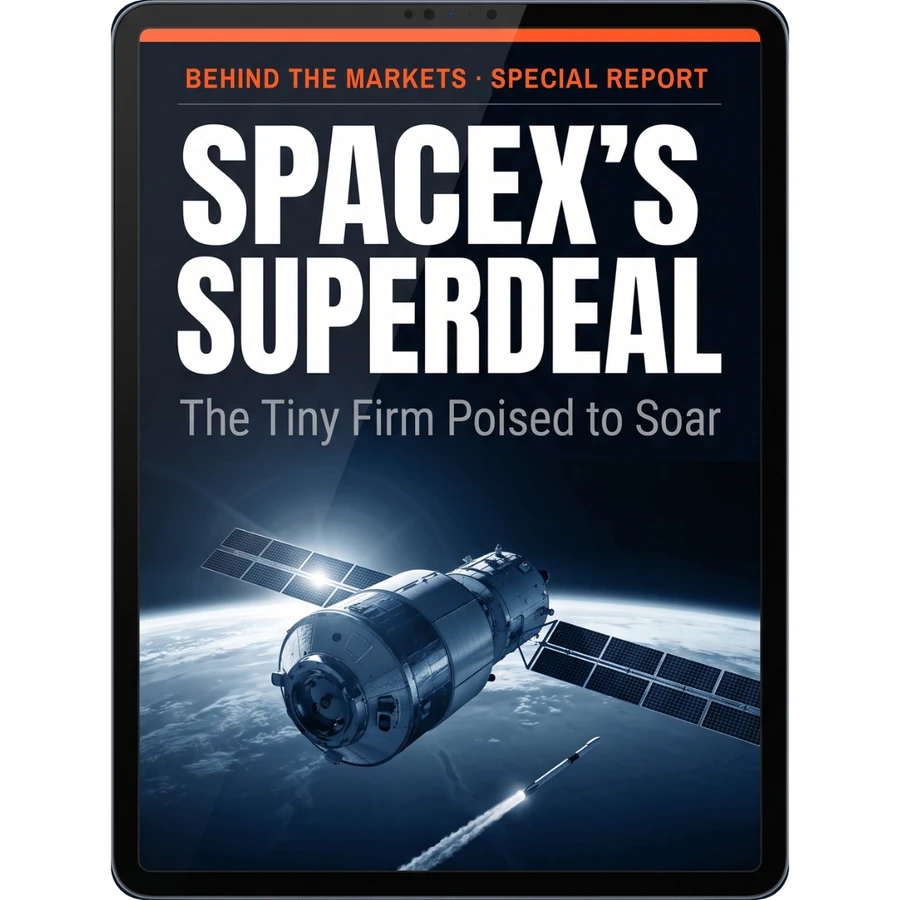
The name, the ticker symbol and my in-depth analysis of the tiny firm poised to build and operate the ISS replacement. You also get a deep dive into their defense arm, which has closed major Pentagon contracts tied to the Golden Dome project — including work on space-based interceptors — with revenues soaring and well over $300 million in backlog across space and defense. That is on top of the historic NASA project. I recommend you get in before October 1st.
And what does a report like that cost?
Nothing.
This report is not for sale anywhere, at any price. But I would like to send you a free copy, which you could have in your inbox minutes from now.
The only thing I ask in return is that you take a look at my research service, Behind the Markets.
Your Invitation to Behind the Markets
I built Behind the Markets for one simple reason: to level the playing field.
For too long, the biggest gains in the market have been reserved for the insiders. The hedge funds, the venture capitalists, and the well-connected elite who get the information before you do.
My mission is to give you that same level of access. For the last 30 years I have used my experience as a market maker and institutional investor to find the stocks Wall Street is ignoring. We do not chase hype. We do not gamble. We hunt for dislocation, the moments where the market is wrong and we are right.
We talked a lot about SpaceX.
The insiders got the big money. The public was not even allowed to invest until SpaceX was twenty-four years old and trading in the trillions.
Sadly, that is becoming the norm.
When I was on Wall Street in the '90s, the typical company stayed private five and a half years.
Today it is more than fourteen years.
That means they are far more expensive by the time you can touch them.
Amazon, Microsoft and NVIDIA all went public at valuations well under $1 billion.
You did not get to buy SpaceX until it hit nearly $2 trillion on IPO day.
Even Larry Fink, the CEO of BlackRock, admits the game is rigged:
 Chairman and CEO, BlackRock
You are locked out.
And I do not think that is right.
See, I was not born with a silver spoon in my mouth.
I was raised by a single mom in Queens who waited tables to put food on the table.
I do not believe everyday Americans should only get Wall Street's leftovers.
That is not how things were when I ran my own brokerage firm, and it is not how they should be today.
And the good news is, there is a way to stack the deck in your favor…
The One Place Where You Beat Wall Street
Think about a fund like BlackRock.
Over $13 trillion under management.
Larry Fink has the connections, the quant team, access to information and research you will never have.
But there is one thing he cannot do. He cannot invest in a tiny firm like this space company.
It is too small. BlackRock needs to put billions to work to move its own needle. It cannot go near a $2.5 billion company.
Even Warren Buffett admitted it:
 Chairman and CEO, Berkshire Hathaway
For once in your investing life, you are the insider — and the fund manager is pressing his face against the glass.
And it gets better.
Wall Street does not even cover these stocks.
Why would they, if they cannot buy them?
Apple has fifty analysts covering it.
The companies I am talking about have a handful.
Some have none at all.
The frontier is the last place in the market where homework still beats a hundred-million-dollar research department.
And that's where I come in.
How I Find The Most Explosive Profit Opportunities:
The Gauntlet
I am not using a secret AI algorithm.
I am not running a high-tech quant strategy.
I do it the old-fashioned way.
I run every stock I find through what I call the Gauntlet.
I throw everything at a company and see what survives.
- No real revenue? Gone. We do not invest in PowerPoints and pitch decks.
- Less than twelve months of cash? Gone. I do not care how exciting the technology is.
- No moat a competitor couldn't copy in eighteen months? Gone.
The overwhelming majority of frontier companies die right there, before we have even looked at the stock price.
And the survivors face the Five Questions.
- Can this company survive a bad year without running back to the market for cash?
- What does it actually cost them to put a dollar to work?
- Is the business creating real value, or quietly destroying it?
- How much real cash is it generating — not the accounting kind?
- And what is this company honestly worth today?
There is more to it than that, and I will not bore you with every detail. All you need to know is this: out of thousands of stocks I screen in a year, only a handful survive the Gauntlet and make it into the Behind the Markets model portfolio.
And I want to be clear about something. Behind the Markets is not a SpaceX newsletter.
We monitor defense, space, quantum computing, obscure AI suppliers — you name it.
Wherever the money goes, we follow.
Simply put, I want to show you the obscure, overlooked companies sitting at the heart of massive megatrends, not yet covered by the mainstream financial media, capable of handing you outsized gains.
And there's one more opportunity I'd like to put in your hands right away:
The Second Stock That Survived the Gauntlet:
Elon's Final Bottleneck
Elon Musk is not just building rockets and satellites.
He has also built one of the most advanced supercomputers on the planet, called Colossus.
And he needs an enormous number of AI chips to feed it.
That is why he is building something called Terafab.
CEO, SpaceXThere is a problem.
To make cutting-edge chips you need an EUV lithography machine.
It is the most complex machine human beings have ever built and it costs over $200 million apiece.
Industry insiders estimate Elon needs hundreds of them.
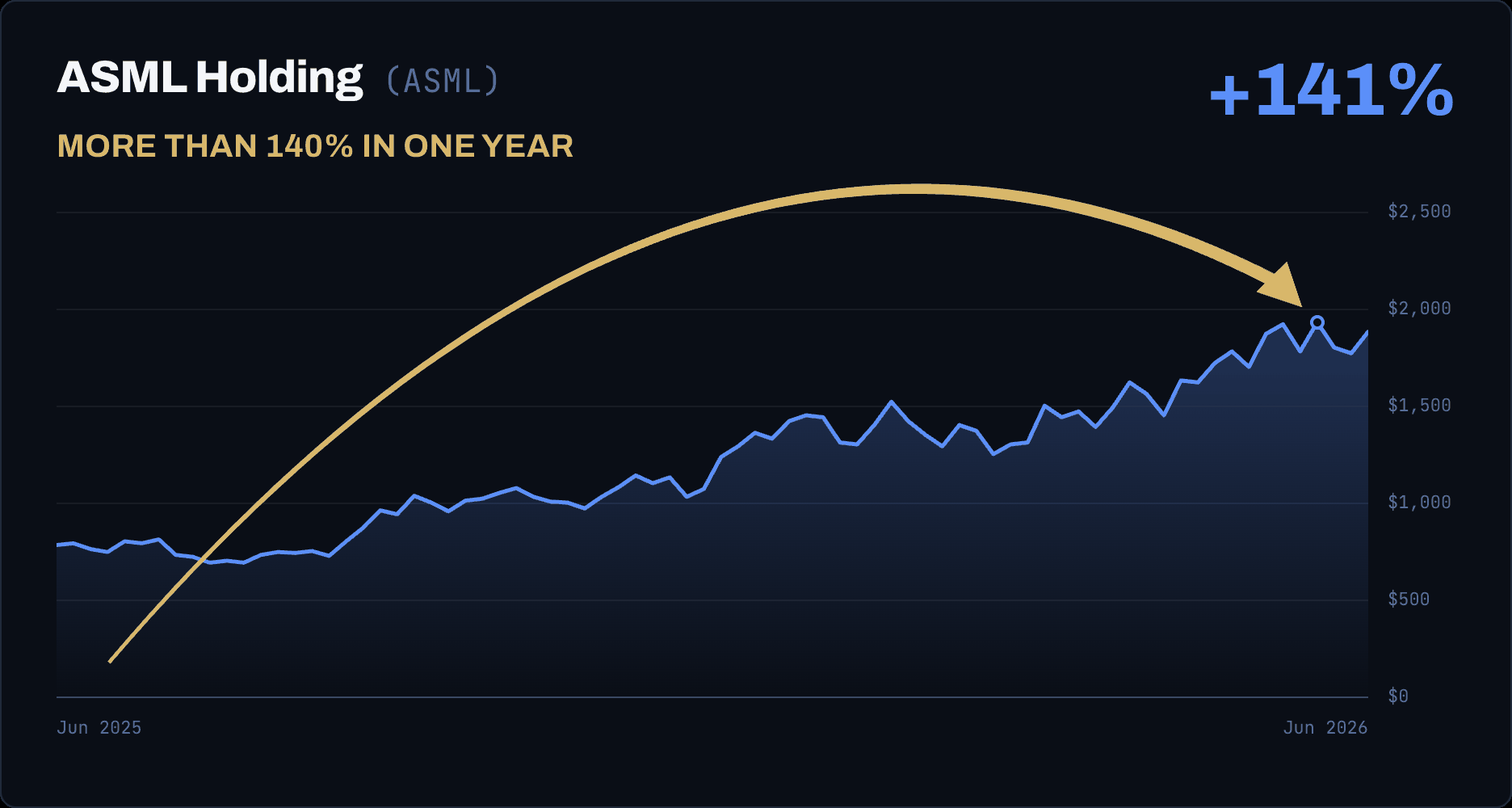
There is only one company on the planet that builds them. It is called ASML, and my readers had the chance to lock in a 141% gain when I recommended it a while back.
The trouble is that ASML cannot keep up.
Last year they shipped just 48 of those machines worldwide.
Why can't they make more?
Because of what is inside the machine.
Every EUV machine contains a CO² laser that fires microscopic droplets of molten tin up to 50,000 times per second.
The heart of every one of these machines is a laser system so precise it hits a droplet of tin, fifty thousand times a second, in mid-air.
And that laser comes from one supplier.
A single family-owned company that nobody reading this can invest in, because it is private.
But there is one obscure public firm that competes with that laser supplier directly.
They practically invented the modern laser industry.
Their founder was a Russian-born physicist who spent decades being told his laser technology would never work.
He built it anyway in a lab outside Moscow, moved it to America, and became a billionaire by creating an entire industry from scratch.
Barely any analysts cover them, because traditionally they are known for industrial lasers.
But they have been quietly moving into AI and robotics, and they have designed one of the most advanced lasers on the market — twice as effective as their competitors, using half the energy.
That could save firms like SpaceX hundreds of millions of dollars, if not billions, in the long run.
These people are secretive.
They do not disclose their customers.
But the CEO recently let it slip that they supply several "major semiconductor equipment makers."
And these lasers are becoming a critical bottleneck for AI.

We have already seen laser stocks take off.
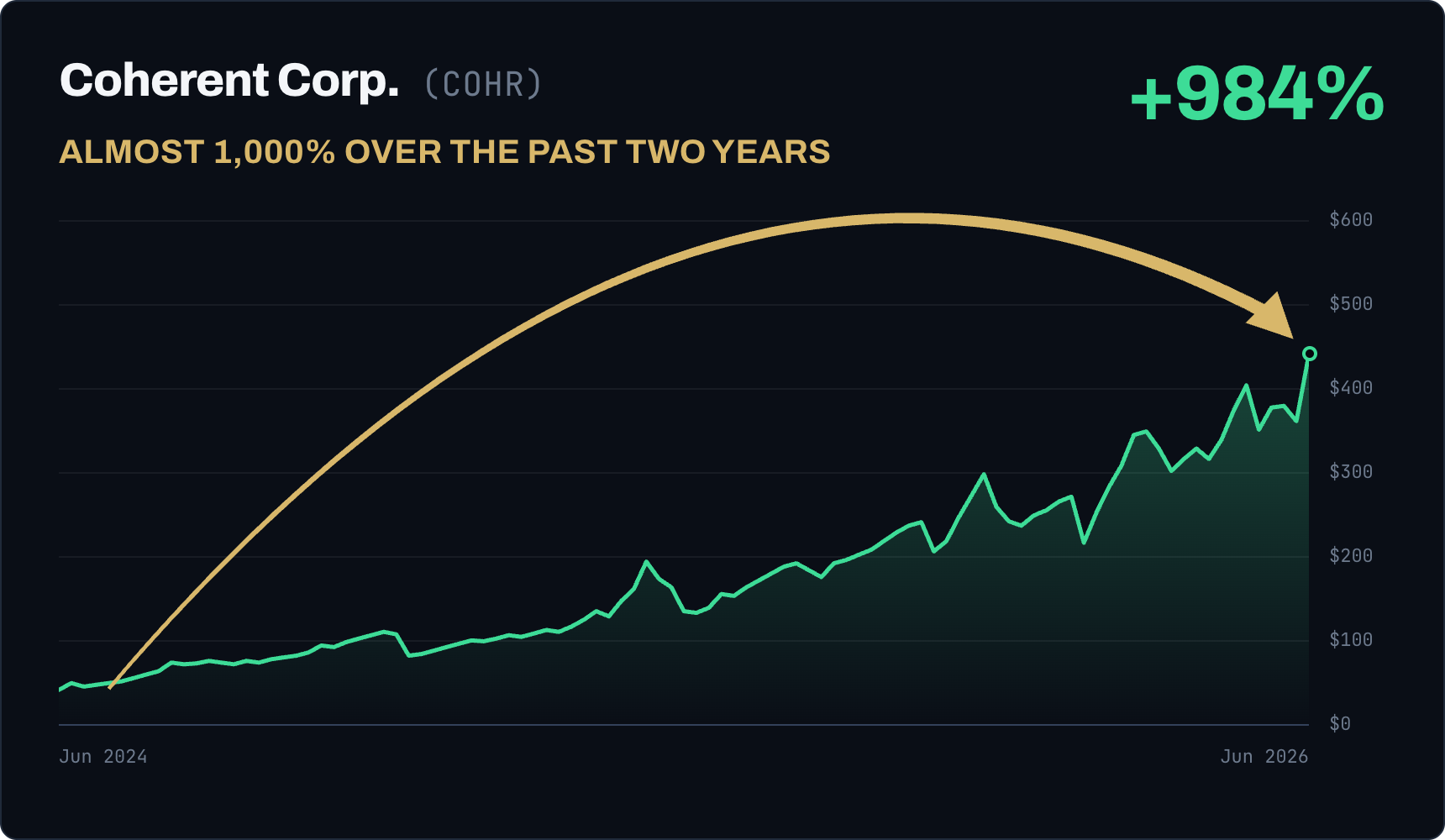
Coherent, backed by NVIDIA, has soared almost 1,000% over the past two years.
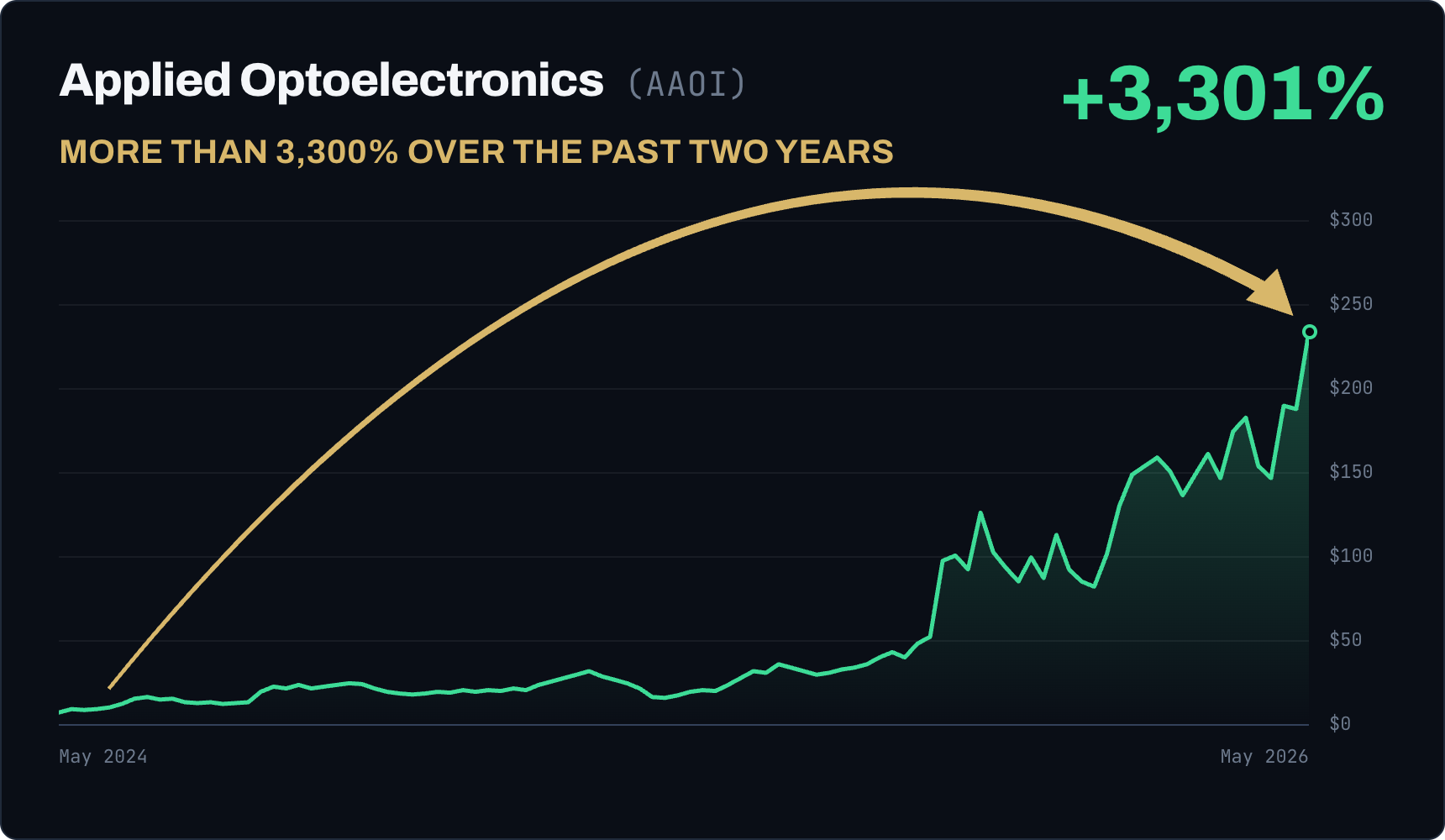
Applied Optoelectronics has surged more than 3,300% over the past two years.
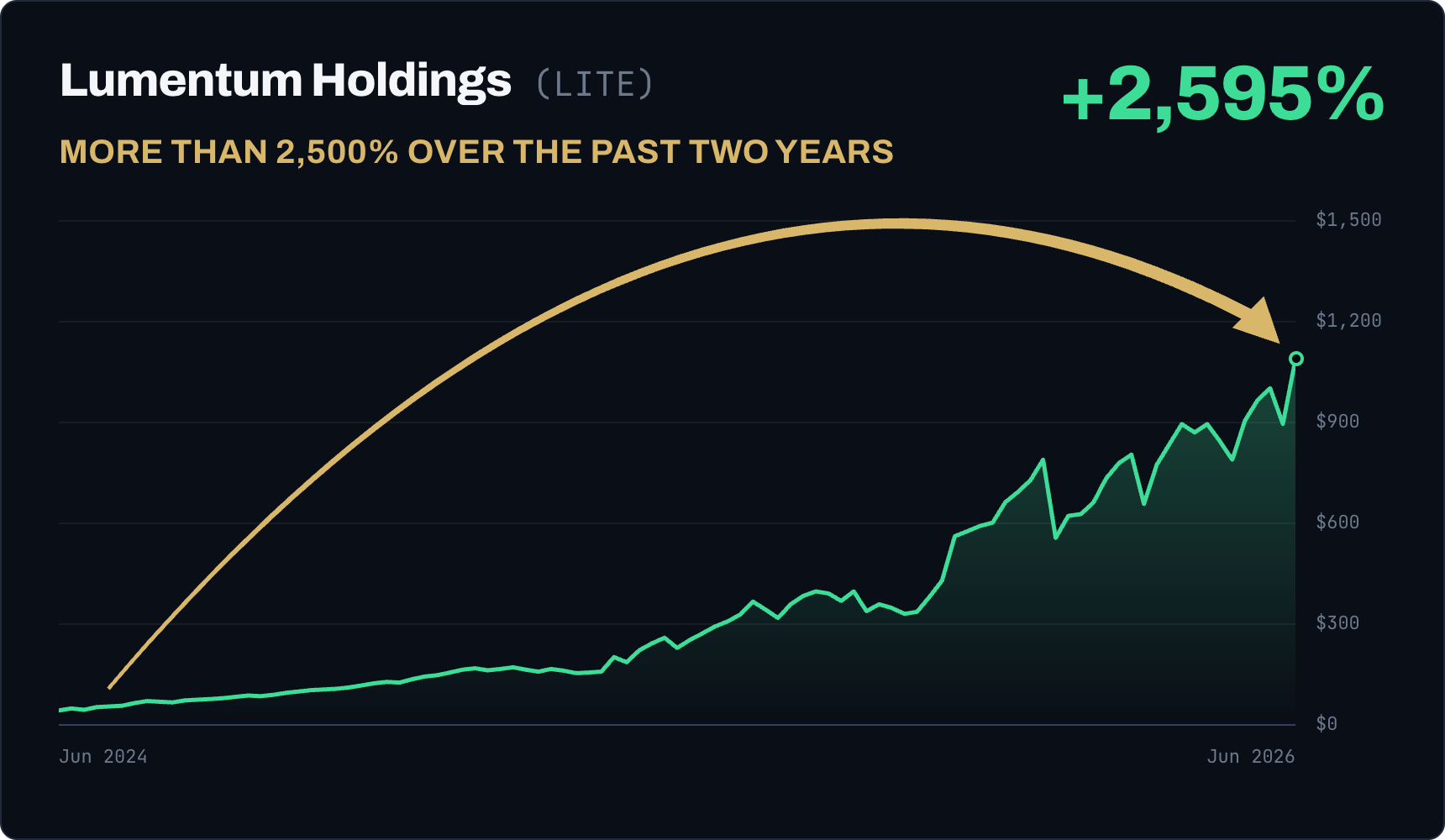
Lumentum has run more than 2,500% over the past two years.
My research indicates this tiny laser firm could be next in line for outsized gains.
Because it is not a traditional AI company, it is still flying under the radar.
Most fund managers could not name it if you gave them the first three letters.
I believe this stock could do very well in weeks and months ahead.
And in a blue-sky scenario?
Say Elon gets tired of waiting for his EUV machines.
He is known for bringing key technologies in-house.
If he puts his eyes on this tiny supplier, shares could make a violent move almost overnight.
That is exactly what happened when Elon was desperate for special E-band amplifiers for SpaceX.
He cut a deal with a small firm called Filtronic.
Shares pumped 58% in a day — and went on to soar over 1,800%.
This is the final bottleneck in the AI supply chain. And that tiny firm is my number one way to play it.
Your second report
Elon's Final Bottleneck: The #1 Laser Stock For the AI Chip Boom
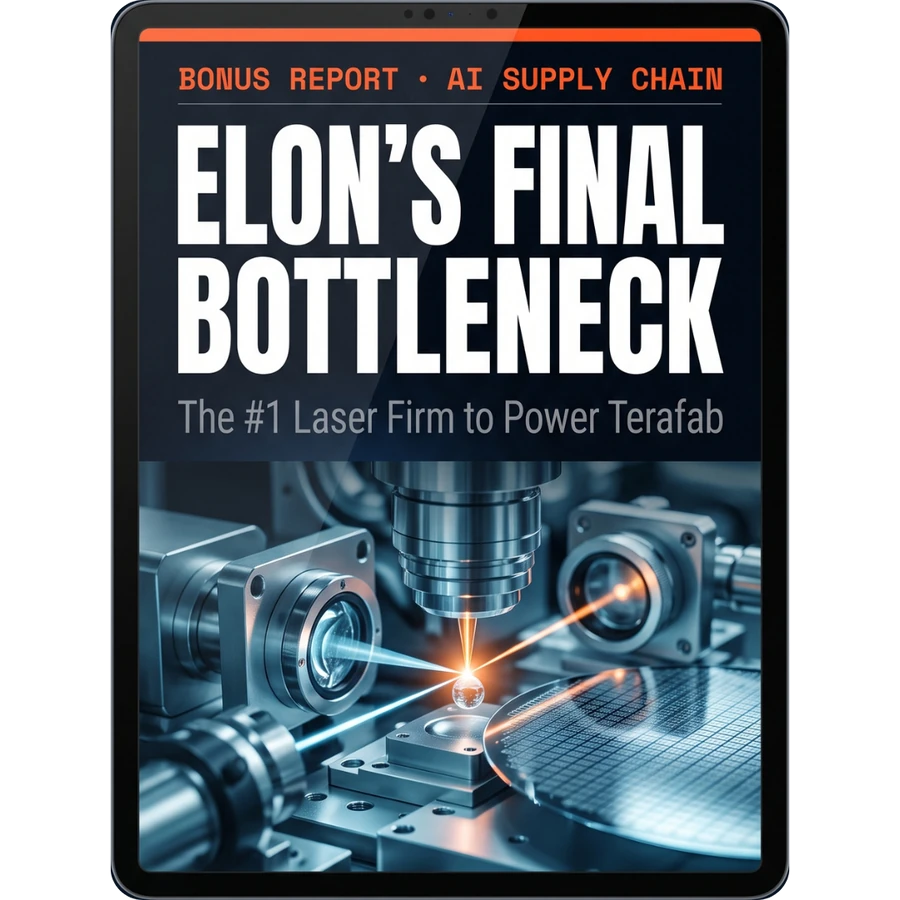
The full story on the one obscure public firm competing directly with the private supplier at the heart of every EUV machine — a company most fund managers couldn't name if you gave them the first three letters. It's yours as a welcome gift when you try out Behind the Markets today.
And One More Thing — Possibly the Most Valuable of the Three
This is bigger than two stock picks. I want to give you the exact screening system I ran both of these companies through, written down step by step.
Your third report
The Gauntlet System
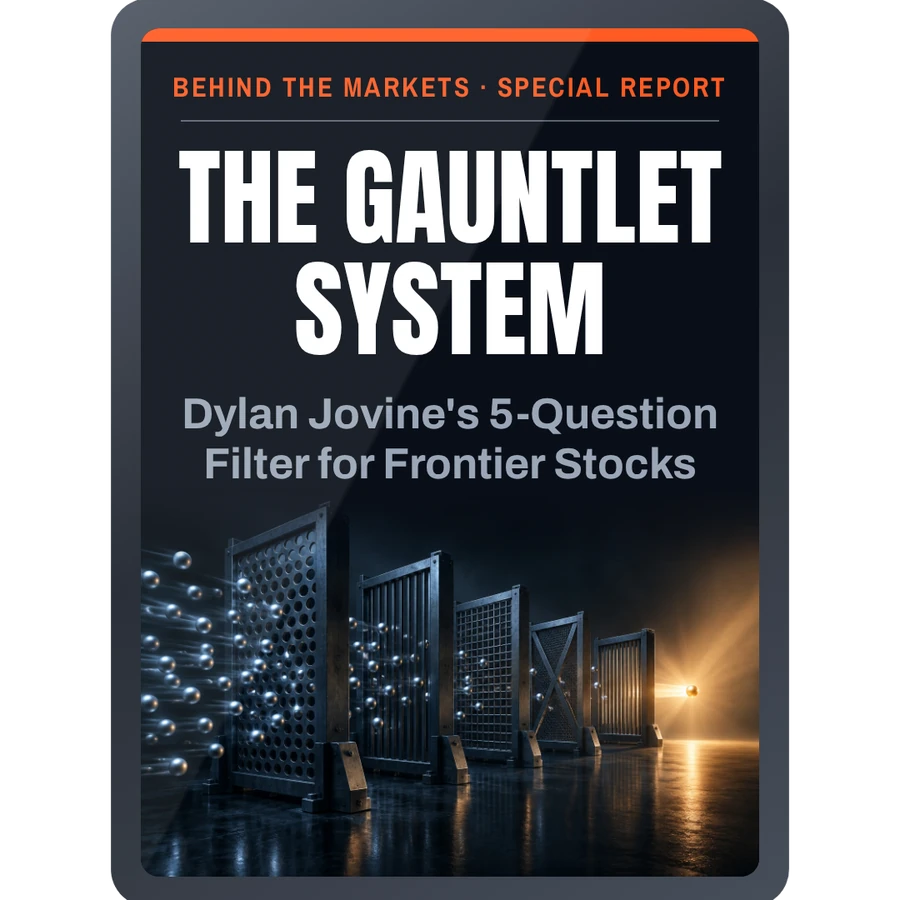
My complete Gauntlet, the screening system that kills the overwhelming majority of frontier companies before I ever look at a stock price. You get the three knockout tests, the Five Questions I ask about every survivor, and a full chapter on position sizing, so one moonshot can change your retirement without taking on unnecessary risk. Yours to keep forever.
Here's Everything You'll Receive
When You Join Behind the Markets Today
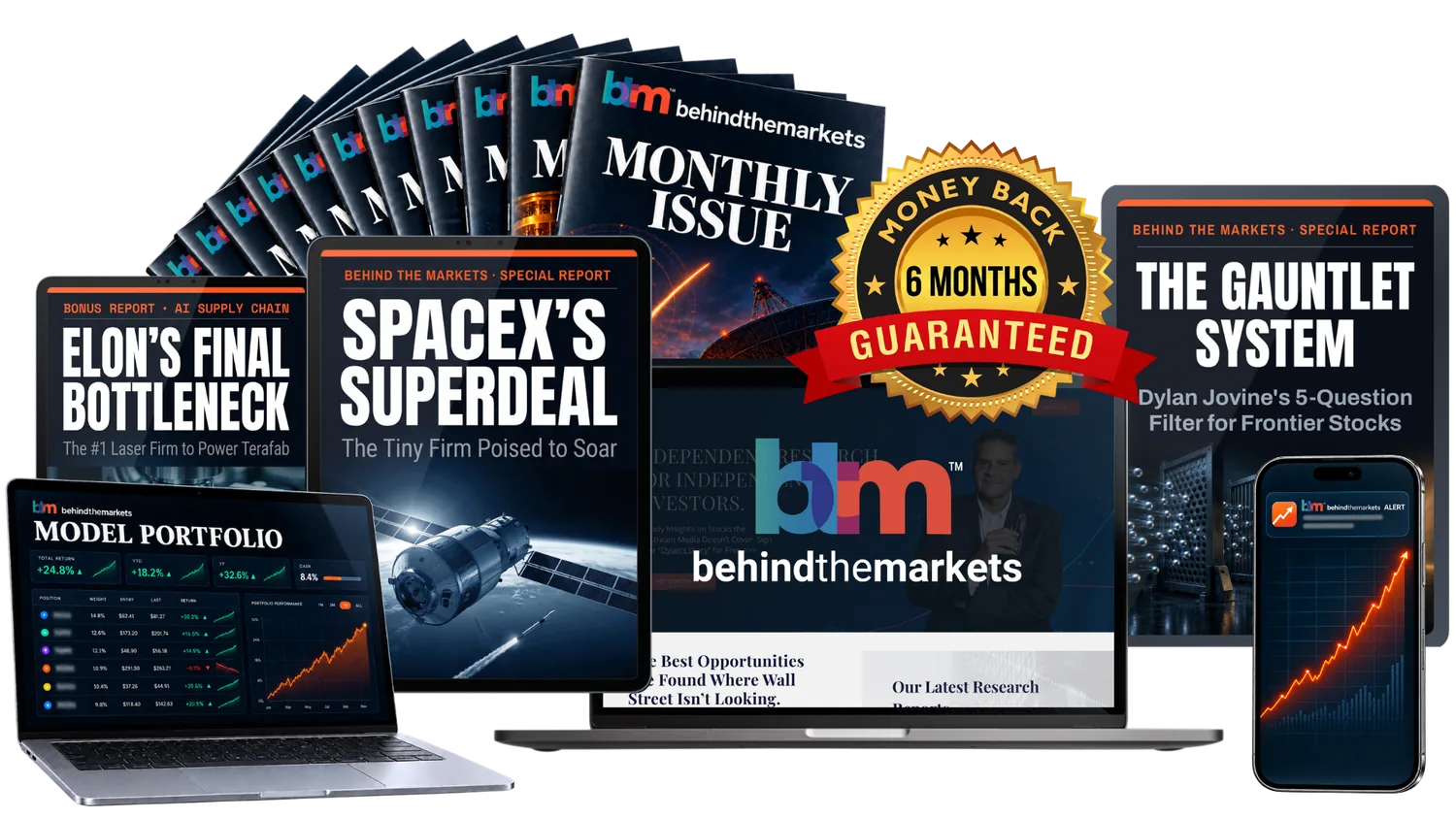
First, my brand-new report: "SpaceX's Superdeal: The Tiny Firm Poised to Soar." The name, the ticker symbol, my full analysis, and a deep dive into the defense arm behind it.
Second, the bonus report: "Elon's Final Bottleneck: The #1 Laser Stock for the AI Chip Boom." The obscure public company at the choke point of the entire AI chip supply chain.
Third, The Gauntlet System. My complete screening system written down, plus a full chapter on position sizing.
Yours to keep forever.
And then the service itself, which is the real value.
Every month you get a brand-new full-length issue of Behind the Markets with my highest-conviction investment idea, delivered on the first of the month.
Every week you get a concise briefing on the model portfolio.
And when it is time to buy or take profits, you get an urgent trade alert straight to your inbox, so you can act in seconds from your phone.
That way you'll never miss out on an urgent opportunity or a chance to take profits.
You also get 24/7 access to our members-only website, where you can view the entire model portfolio, every open position with its entry price and current gain, plus the full archive of past reports.
If NASA moves on this tiny space firm, or Elon cuts a deal with the laser supplier in your second report, you will hear about it first.
That is the whole point of the service.
Plus U.S.-based customer support. Our team of experienced agents, based in South Carolina, can help with any question about your subscription. Call or email any time Monday to Friday, 9am to 5pm ET.
Now Let's Talk About the Price
I have a thirty-five year track record of finding these frontier investments.
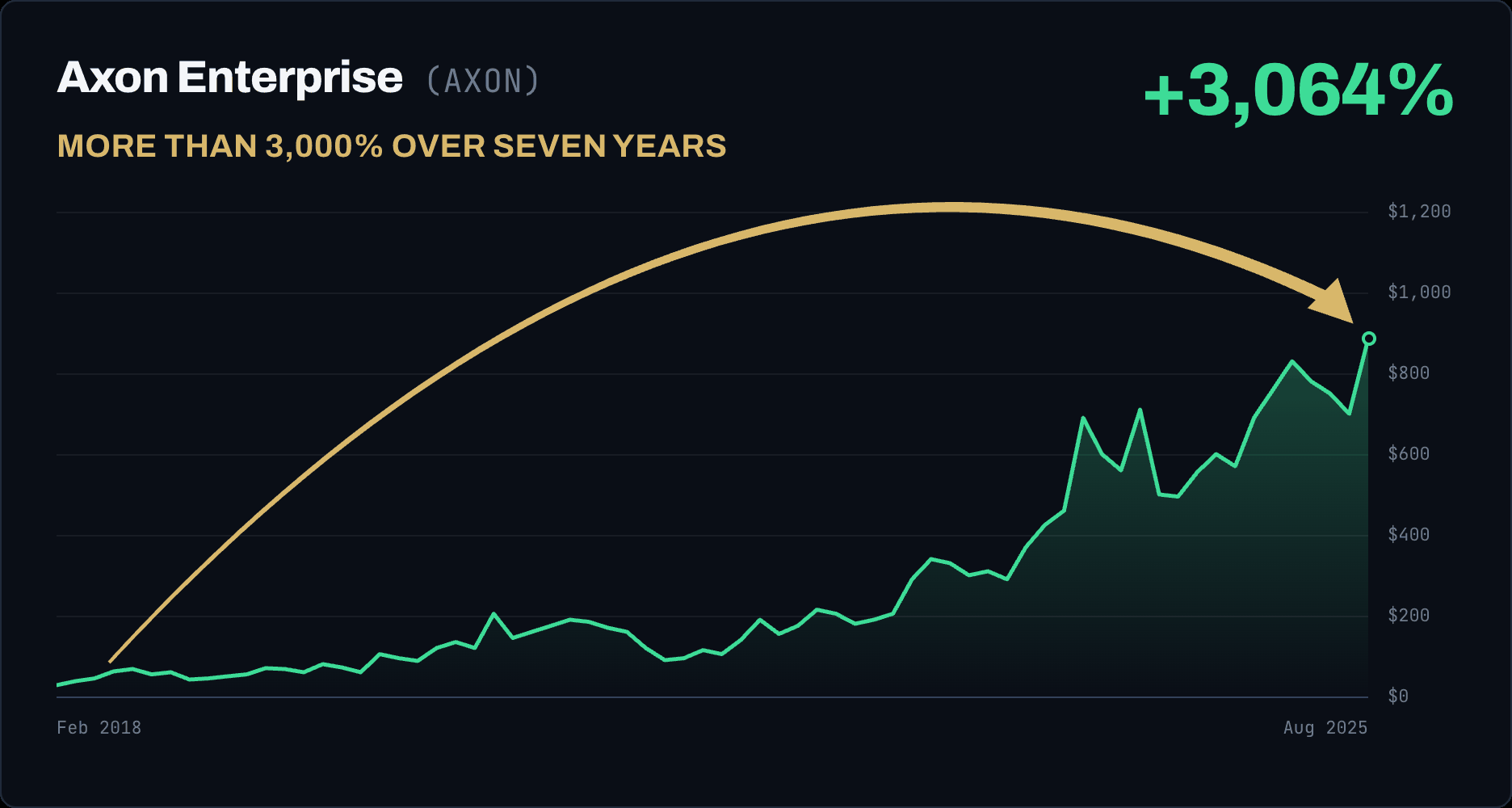
I recommended one tiny company called Axon at $28, and it went on to soar as high as $885 — a gain of over 3,000%, enough to turn a $5,000 investment into $155,000.
I firmly believe Behind the Markets offers better research than services charging $5,000 or $10,000 a year.
That single Axon recommendation would have covered a membership fee for decades.
Now, the retail price to join Behind the Markets is only $399 per year.
That is the regular price listed on our website right now.
And I believe that's a steal.
But I know that trust is earned.
You might not know me yet. And I do not want price to be the reason you miss out on this tiny space firm.
That's why I'm prepared to make you a special offer today.
Here is what it costs to try out Behind the Markets today.
For a limited time, I am authorizing a massive discount for new subscribers.
You will not pay $399.
You will not pay $199.
You will not even pay the standard discounted rate of $99.
If you act right now, through this page, I am slashing the price by an additional 50%.
That is not a typo. $49. It breaks down to less than 13 cents a day, less than the cost of a sandwich.
For just $49 you get the SpaceX Superdeal report, Elon's Final Bottleneck, The Gauntlet System, and a full year of my guidance.
I know that once you start reading my research and seeing the results in your own brokerage account, you will be a subscriber for life.
I am willing to lose money on this upfront offer just to get my foot in the door and prove my value to you.
But I cannot keep it open forever.
And remember, is the date that matters for the stock itself.
Moneyback guarantee
My Ironclad Double Guarantee
Guarantee #1: The 100% Satisfaction Promise. Sign up today, pay the $49, download the reports and buy the stocks. If at any point in the next six months you are not completely thrilled, if you do not feel this was the best $49 you ever spent, just contact our customer service team and we will refund 100% of your subscription fee.
Guarantee #2: You Keep Everything. Even if you ask for a refund, you keep the reports, the research and the ticker symbols. They are yours as my way of saying thank you for giving us a try.
There is no risk to you.

Dylan Jovine
CEO & Founder
Full Recap: Here's What You Get Today
Your price today
for one full year of Behind the Markets
Less than 13 cents a day. You can review your order before it is final.
The Choice Is Yours
I have shown you a $150 billion laboratory coming down, a tiny company already building what could replace it, and a NASA rent budget worth more than the entire firm inside of three years.
I have shown you what happens to a small space stock the day NASA's name lands beside it — 66%, 155%, 225% in a single session.
And I have shown you a hard date on the calendar. is when NASA's new fiscal year starts and the money for the ISS replacement is unlocked.
From that point on, the announcement can cross the ticker on any given morning. There is no warning shot. The announcement is the move.
If you wait even one day, shares could be trading much, much higher.
Remember what I have found on the frontier before.
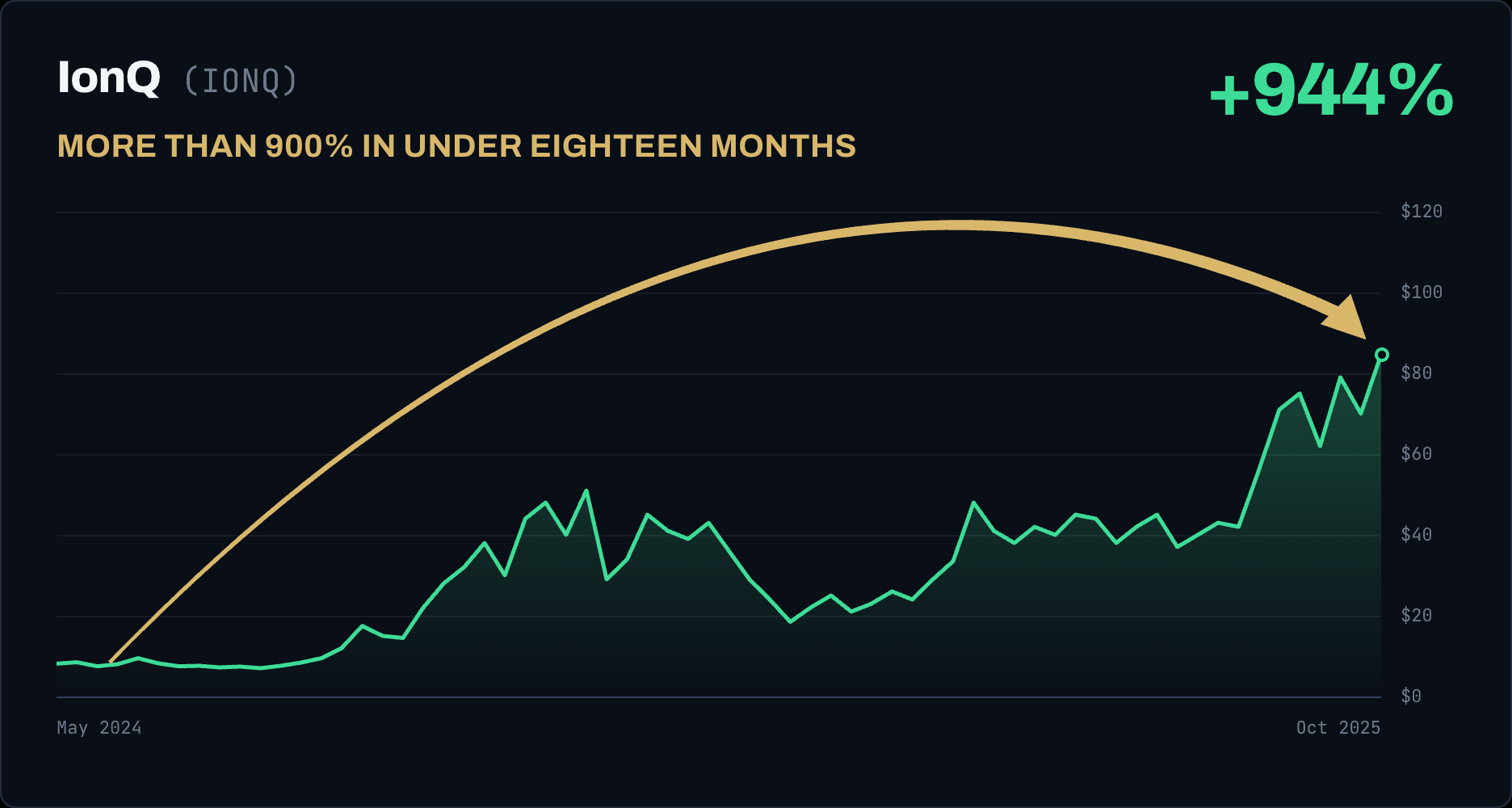
IonQ, which soared as high as 944%…
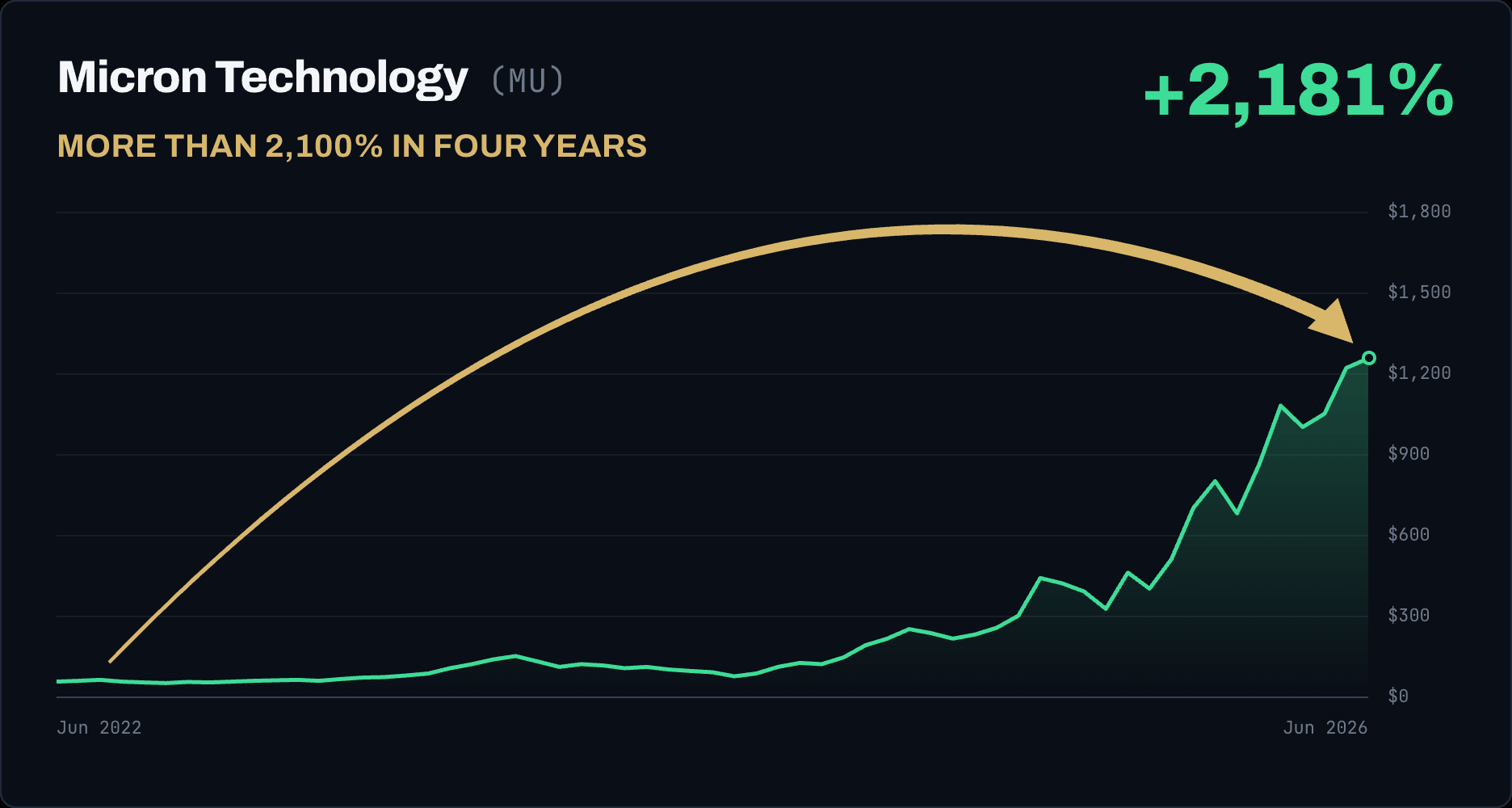
Micron, before a 2,181% run…
And Rocket Lab, before it exploded almost 3,900% — a single stock that could have turned $5,000 into nearly $200,000.
Past performance does not guarantee future results. These are peak returns, not realized ones.
Now I have found a tiny space company that I believe could do even better.
It teamed up with SpaceX on what SpaceDaily calls the most expensive demolition job ever commissioned.
Elon gets to destroy the $150 billion ISS. This firm is already building a replacement.
Their design has cleared NASA's review.
Major defense giants scrapped their own space station plans to join them.
They have already built a life-size mockup.
And the final NASA announcement could hit the news any day now.
So click the button below, risk $49 that is fully refundable, and get positioned right now.
Founder, Behind the Markets